Mexico’s Struggle to Build an Independent Labor Movement
Throughout most of the last century, the Mexican labor movement has largely seen its unions become corrupt instruments of state control. That’s slowly beginning to change, but the road to independent, democratic Mexican unionism remains a steep one.
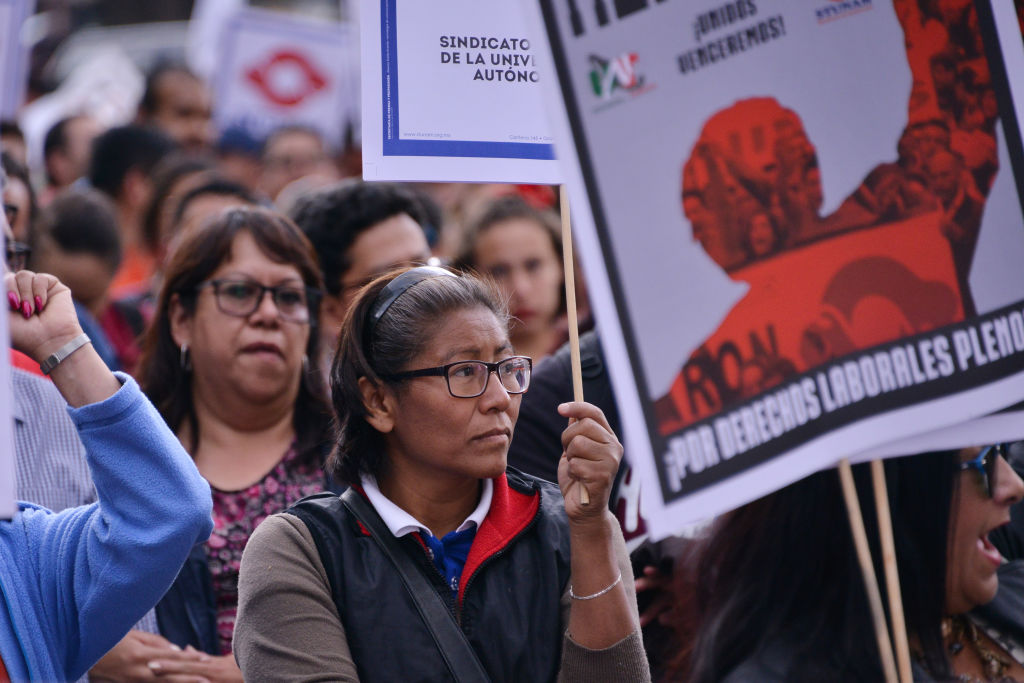
Union members take part in a labor demonstration in Mexico City, 2020. (Eyepix / NurPhoto via Getty Images)
The labor regime of the neoliberal period in Mexico is in full decline. It was already a degeneration of the successful corporatist system, a one-party political structure in which the state controlled the unions under the long-ruling Institutional Revolutionary Party (PRI). Unions not only became state-dependent under the PRI’s corporatist system but also entered a social pact with corporations to suppress wages and labor strife through “protection contracts,” so named because they protect employers from genuine worker organizing.
This corporatist system was in full swing from the 1930s through the 1960s, when the Mexican economy grew rapidly — the fastest in Latin America — and workers organized in national industrial unions and confederations like the Confederation of Mexican Workers (CTM), the Revolutionary Confederation of Workers and Peasants (CROC), and the Regional Confederation of Mexican Workers (CROM) were rewarded with relatively good salaries and conditions.
But with the erosion of the corporatist system and the rise of neoliberalism, beginning in the 1980s, the labor regime was restructured through austerity budgets, the privatization of state enterprises, deregulation of price controls, salary caps, conversion to lean production, and the lowering of trade restrictions. These shock therapies retooled the global economy to serve the profit imperatives of big business and the wealthy, while demobilizing labor unions, which meant lower wages and fewer benefits for union workers.