Sweden’s New Government Is Dominated by the Far Right’s Agenda
New Swedish prime minister Ulf Kristersson comes from a party called the Moderates. But his majority relies on the votes of the far-right Sweden Democrats — and their pressure is already visible in his plans for government.
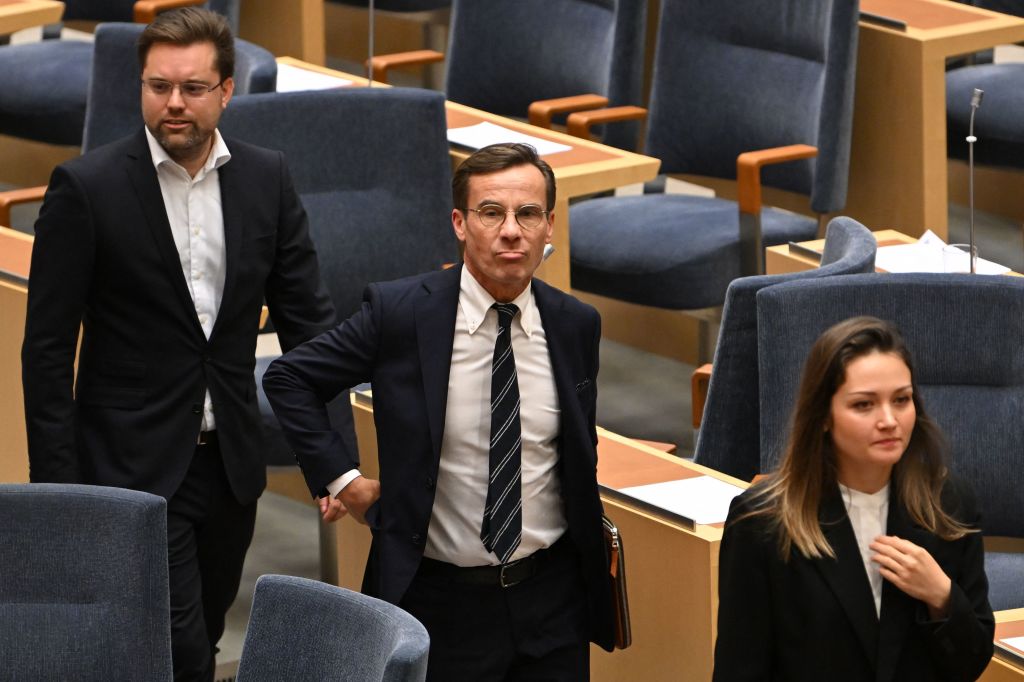
The leader of Sweden’s Moderate Party and newly elected Swedish prime minister Ulf Kristersson after the parliament session electing him on October 17, 2022. (Jonathan Nackstrand / AFP via Getty Images)
Sweden’s election on September 11 might be seen as a narrow win for the right-wing bloc: it scored 49.6 percent of the vote, just beating the coalition led by incumbent prime minister Magdalena Andersson, at 48.9 percent. But the real change was behind these numbers. While Andersson’s Social Democrats were the biggest single party, with 30 percent support, the single fastest-rising force was the far-right Sweden Democrats (SD), a party founded by neo-Nazis in the 1980s. Today an established part of the parliamentary landscape — other parties stopped boycotting it in 2018 — it scored 20 percent to become the single biggest force within the right-wing bloc.
The SD won’t lead the government, for now. After over a month of coalition talks, this Tuesday Ulf Kristersson of the Moderates, the traditional center-right party, became the new prime minister. His cabinet also consists of Liberals and Christian Democrats, but crucially, in parliamentary votes he will be dependent on the SD’s support. This was first tested as the new parliament voted Kristersson in as prime minister by 176 votes to 173.
Ali Esbati is an economist and MP for the Left Party, reelected last month, who is also known as a survivor of the 2011 terrorist attack by the Norwegian fascist Anders Breivik at Utøya. Jacobin’s David Broder spoke to him about what the SD’s rise means and what the Left can do it resist it.