All of Us Should Be Able to Live Like Peep Show’s Jeremy
The British sitcom Peep Show depicts the life of a 2000s unemployed guy who lives comfortably. Today, austerity has all but destroyed the possibility of such a slacker lifestyle — an option we all deserve.
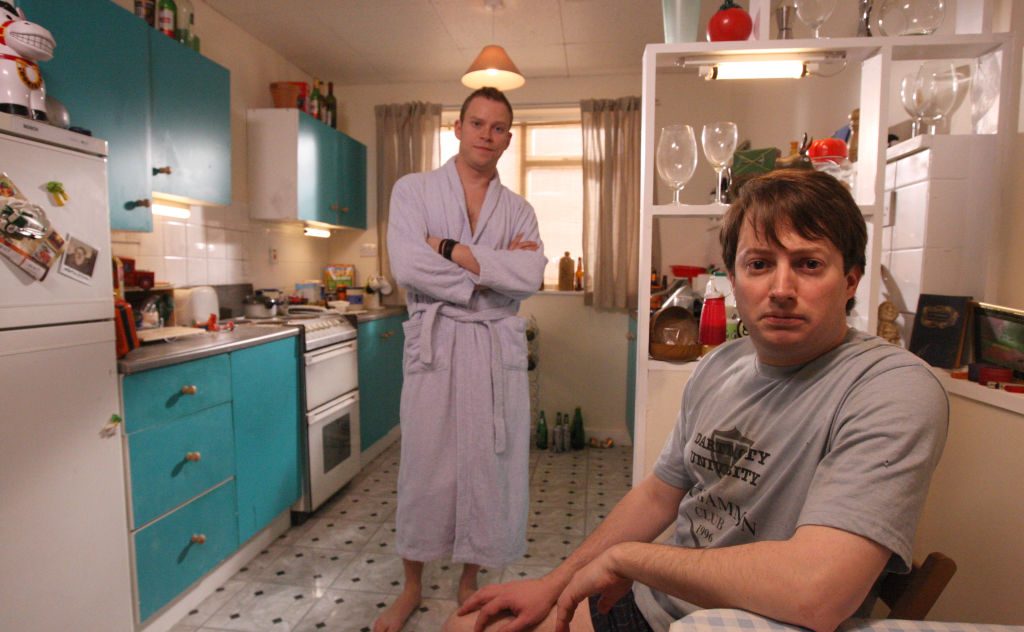
David Mitchell and Robert Webb on set in North London filming Peep Show. (Ian West / PA Images via Getty Images)
The point of Peep Show (2003-2015) is that both its protagonists, Mark Corrigan (David Mitchell) and Jeremy Usbourne (Robert Webb), are abject and despicable losers. Yet watching it recently for the first time in years, I felt a trace of envy. Jeremy is an unemployed slacker, and yet his life, while bleak, holds an unintentional allure. I too would like to have recourse to a “nest egg” or free accommodation, but none of my friends are rich enough for me to mooch off. My parents, while middle class, are too Presbyterian to fund my efforts to make it as a DJ. There is something in this loser’s life that I can’t really aspire to.
The allure of Jeremy’s life owes partly to the nature of narrative fiction: Hitchcock once said that “Drama is life without the boring parts,” and the same is true of sitcoms. We never see Jeremy spending hours watching daytime television or filling out forms at the jobcenter. Instead, he takes drugs, goes to the pub, has escapades, and pursues a series of disastrous love affairs — all of which seem preferable to working.
“As a viewer, you are both appalled and thrilled by Jeremy’s actions and outlook,” Craig Telfer, cohost of the Review From the Terrace podcast, which recently reflected on Peep Show, told me. “Appalled that someone so selfish, reckless, and impulsive can coast through life with no consequences for their actions, but thrilled because in some way because you wish you could be like that, too: untethered from the real world.”