In Today’s Election, the Survival of Brazil’s Democracy Is at Stake
Today, Brazilian voters are not just choosing between Bolsonaro and Lula — the far right and the Left — but whether their nation's politics will be authoritarian or democratic.
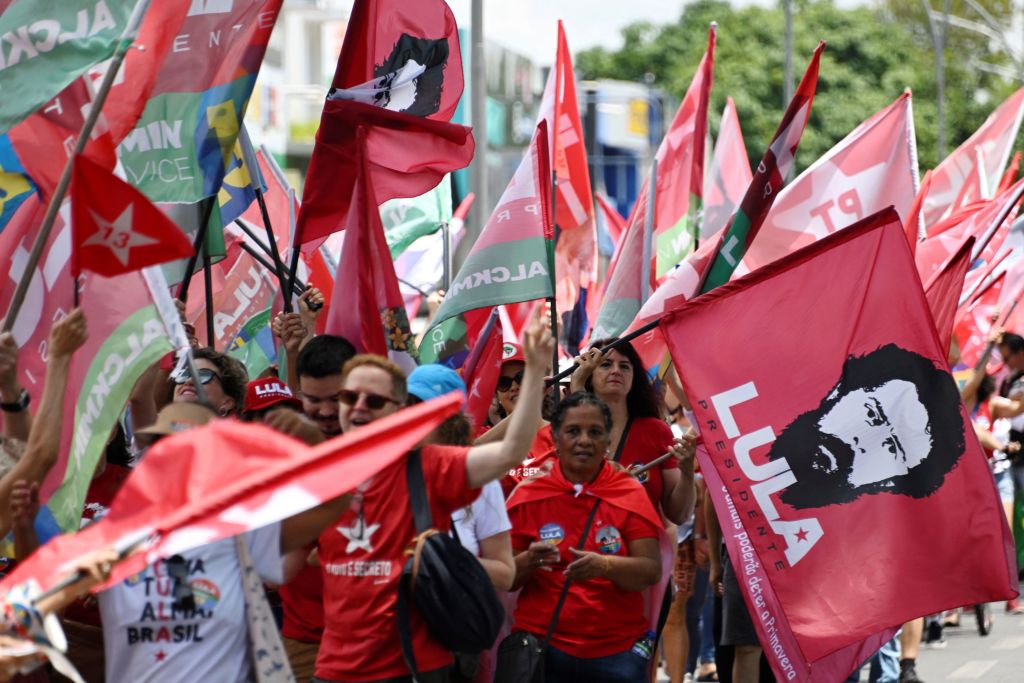
Supporters of Luiz Inácio Lula da Silva wave flags during a campaign rally in a street in Brasília, on October 29, 2022. (Evaristo Sa / AFP via Getty Images)
Today, more than one hundred million Brazilians will vote in the second and final round of the country’s presidential election, which pits former president Luiz Inácio “Lula” da Silva against extreme-right incumbent Jair Bolsonaro. In the first round, held earlier this month, Bolsonaro finished more than five points behind Lula and seems poised to become the first Brazilian president ever to lose reelection. Nonetheless, polls have seemed to tighten in recent weeks and many observers expect a close contest today — raising the ominous prospect that Bolsonaro may refuse to concede defeat and attempt to cling to power.
What are the issues at play in Brazil’s historic election? How have the politics of COVID-19 factored in? And what does the future hold for the far-right project of Bolsonarismo, even if the man at its center loses the runoff? To explore these questions, Jacobin’s Luke Savage sat down with Vincent Bevins — who lived in Brazil from 2010 to 2016 and worked as a correspondent, wrote The Jakarta Method (which came out in 2020), and moved back to São Paulo last year to work on his second book.
Luke Savage
To start with the basics: because neither major candidate received over 50 percent of the vote earlier this month, Brazil is going to be voting in the second round of its presidential election on October 30. Before we get to the runoff, can you walk us through what transpired in the first round a bit? The general impression seems to be that Lula somewhat underperformed what some polls suggested was possible. Can you explain the results of the first round and give us your impression of them?
Vincent Bevins