Joe Biden’s New National Security Strategy Puts US Global Dominance First
Despite its flowery rhetoric about transnational cooperation, Biden’s new National Security Strategy ultimately recommits to a basic principle of ruling-class foreign policy: US hegemony, now and forever.
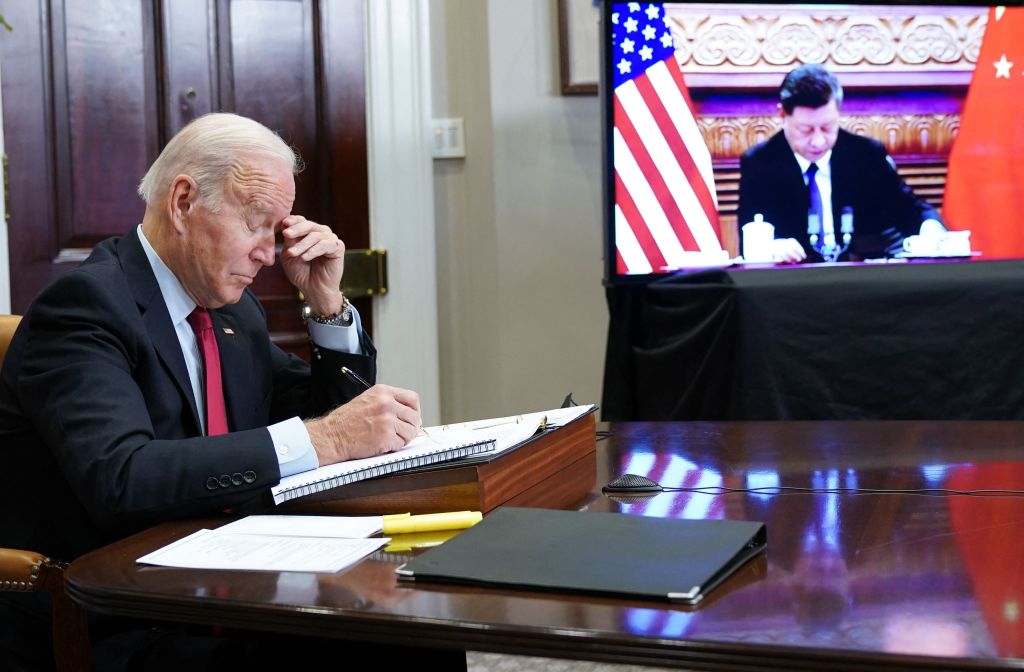
President Joe Biden gestures as he meets with China’s President Xi Jinping during a virtual summit from the White House in Washington, DC, November 15, 2021. (MANDEL NGAN / AFP via Getty Images)
Don’t be fooled by the progressive rhetoric of the Biden administration’s new National Security Strategy (NSS), released earlier this week. With the document, the administration is recommitting to a basic principle of ruling-class foreign policy: US hegemony now, US hegemony forever.
At a moment of uncertainty in the global order, President Biden is cribbing from the same playbook that previous administrations have consulted in moments of geopolitical flux. And Biden is again prioritizing US dominance over cooperation and a more democratic global order.
In the past century, there have been two major shake-ups in the global order: the first following World War II and the second following the fall of the Soviet Union. In the wake of World War II, Washington fashioned an anti-communist, liberal internationalism to box out the Soviet Union in an attempt to shape the new world. It was an inherently colonial internationalism, with the United States holding a disproportionately powerful position in the United Nations. Throughout the Cold War, the United States flouted its ostensible guiding principles as it undercut the right to self-determination that colonized peoples were fighting for — often toppling democracies to achieve strategic ends.