Queens Has Quietly Become a Hub of Left-Wing Organizing and Socialist Electoral Wins
In parts of Queens, socialists hold office at the local, state, and federal levels. Those victories are no accident: they’re the fruit of years of local organizing in a borough known for being anything but flashy.
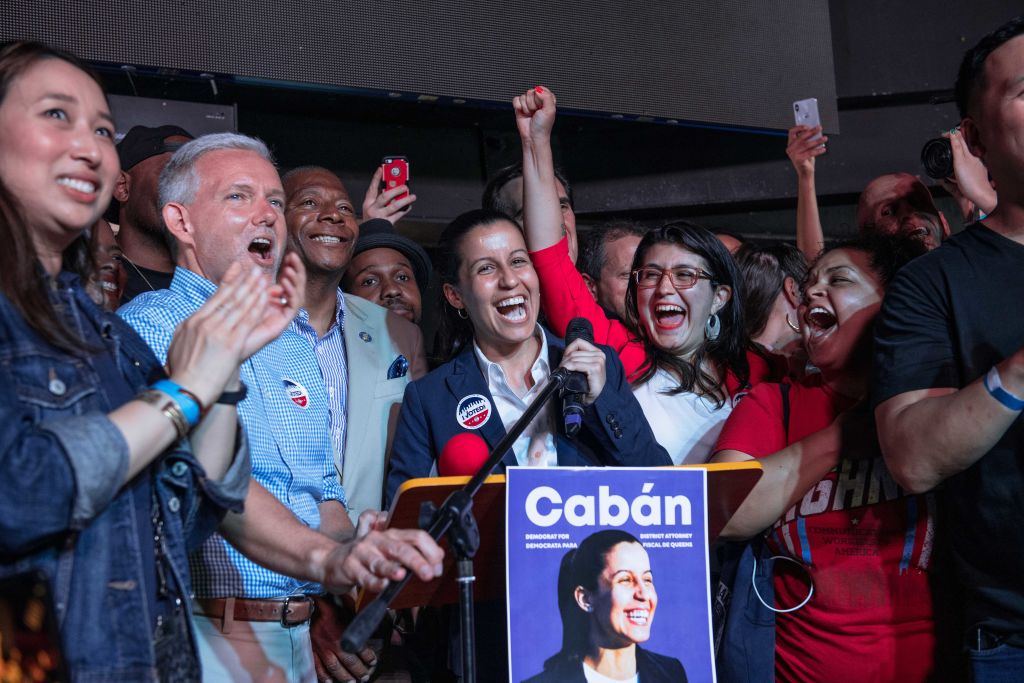
Public defender Tiffany Cabán celebrates her victory with supporters after the Democratic primary for Queens district attorney on June 25, 2019. (Scott Heins / Getty Images)
With the recent certification of the August 23 primary election results, Kristen Gonzalez is officially the Democratic nominee for State Senate District 59, which spans western Queens, northern Brooklyn, and parts of Lower Manhattan on the far east side. In parts of Astoria, Queens, socialists are present in every level of government: Congresswoman Alexandria Ocasio-Cortez (AOC), Assemblymember Zohran Mamdani, City Council member Tiffany Cabán, and soon-to-be State Senator Kristen Gonzalez (who is running unopposed in the general election in November 2022). As a result, many people are now affectionately referring to the western Queens neighborhood as “the People’s Republic of Astoria.”
This is especially noteworthy because Queens is not historically a place associated with the cutting edge of political and social change. On network television, Queens has historically been a cultural backwater, a provincial place you wanted to leave, like The Jeffersons, Fran Drescher’s The Nanny, or George Costanza’s parents in Seinfeld. These days, Queens has been dubbed “The World’s Borough,” famous for its immigrant populations, two airports, and incredible ethnic and linguistic diversity.
But compared to neighboring boroughs to the south and west, Brooklyn and Manhattan, Queens is somewhat of a “flyover state” of the five boroughs, a place many New Yorkers only see from the highway en route to JFK Airport or the Rockaways, but otherwise an outer boroughs joke, with a landscape decimated by Robert Moses’s multilane interstate exchanges, suburban mini-mall type construction, and earnest immigrant ambitions. As City and State noted in 2021, any political observer prior to 2018 would assume a socialist upset might come from more culturally cutting-edge neighborhoods like the East Village or waterfront Brooklyn. That changed with AOC’s surprise primary upset in 2018. While some observers have suggested that “demographic changes” like gentrification explain AOC’s victory, such claims often ignore the specificity of Queens’s communities. Queens by its nature has a unique set of cultural, physical, and social conditions that enabled dense social, solidaritistic, civic networks. These conditions allowed for surprising inroads for socialist electoral and left victories.