Italy’s Poll Leader Says It’s “Conservative” — but Its Ideology Has Clear Fascist Elements
- David Broder
Leading polls for September’s general election, Giorgia Meloni has again distanced her party from the Mussolini era. Yet its politics remain based on ethnonationalism, anti-communism, and the rejection of Enlightenment values.
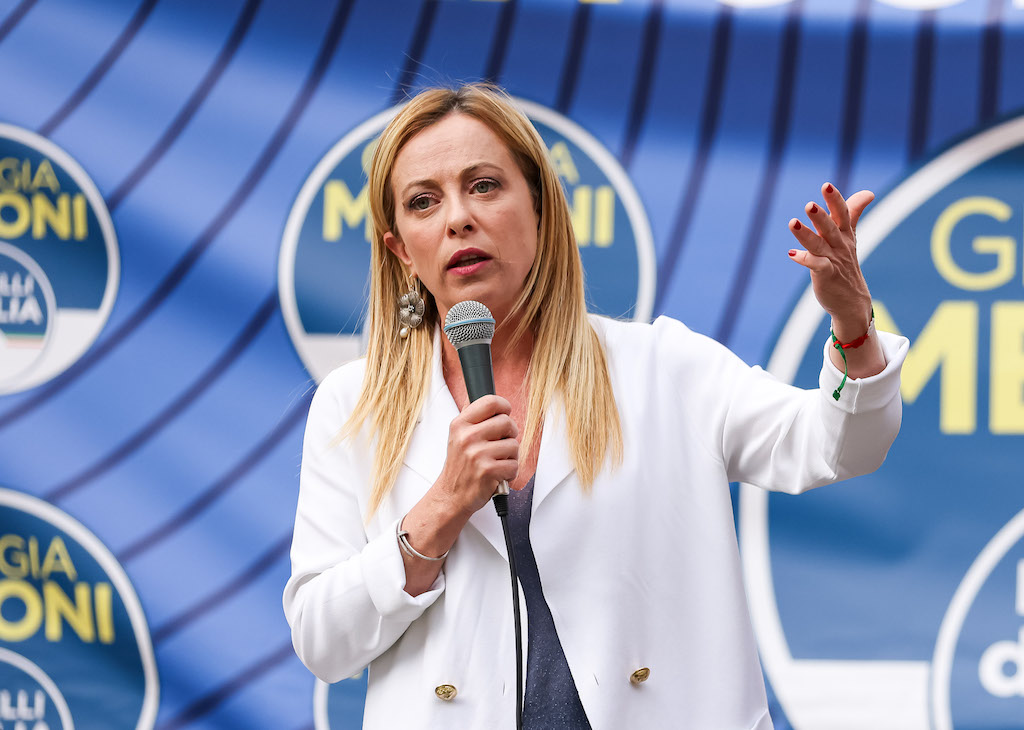
Fratelli D’Italia party leader Giorgia Meloni attends a rally in Piazza Roma on May 30, 2022 in Monza, Italy (Alessandro Bremec / NurPhoto via Getty Images)
Giorgia Meloni has put her name forward for Italy’s next prime minister, if her coalition wins a majority in next month’s election — and judging by current polls, she is all but guaranteed to achieve this. The “center-right” coalition formed by her Fratelli d’Italia party, Matteo Salvini’s Lega, and Silvio Berlusconi’s Forza Italia is expected to take 45-47 percent support in the September 25 vote — with Meloni’s party garnering around half of this total. Given Italy’s electoral system, such a vote would hand the right-wing parties a clear majority of seats.
The opposing side of Italian politics has seen the resounding failure of the attempt, mounted by Enrico Letta’s Partito Democratico, to build a broad center-left coalition. It is instead fragmented into several rival formations. In the center is an alliance between two ultraneoliberal parties (Matteo Renzi’s Italia Viva and Carlo Calenda’s Azione). They stress their continuity with the policies of technocrat Mario Draghi’s outgoing government. On the left-liberal and pro-NATO side, Letta’s Democrats have managed to gather the support of only a few minor forces, with conflicting orientations. The eclectic Five Star Movement, breaking its previous pact with the Democrats, has refused an understanding with other forces. The radical left, which dropped out of parliament in 2018, has instead reorganized into the Unione Popolare, led by former Naples mayor Luigi de Magistris.
With such a strong chance of leading the next government, Fratelli d’Italia is moving in two tactical directions. First, it has prioritized the issue of Meloni’s candidacy to lead a possible right-wing government. The aim is to boast of her own popular legitimacy and avoid post-election maneuvers by allies seeking to impose another figure unrelated to the individual parties. Second, it is trying to present a reassuring profile as a fundamentally pro-system party.