Technocrats Will Never Stop the Far Right, in Italy or Anywhere Else
Former central banker Mario Draghi has resigned as Italian prime minister, pushing the country into snap elections. Best-placed to benefit is the only major force that opposed his government: Giorgia Meloni’s far-right Fratelli d’Italia.
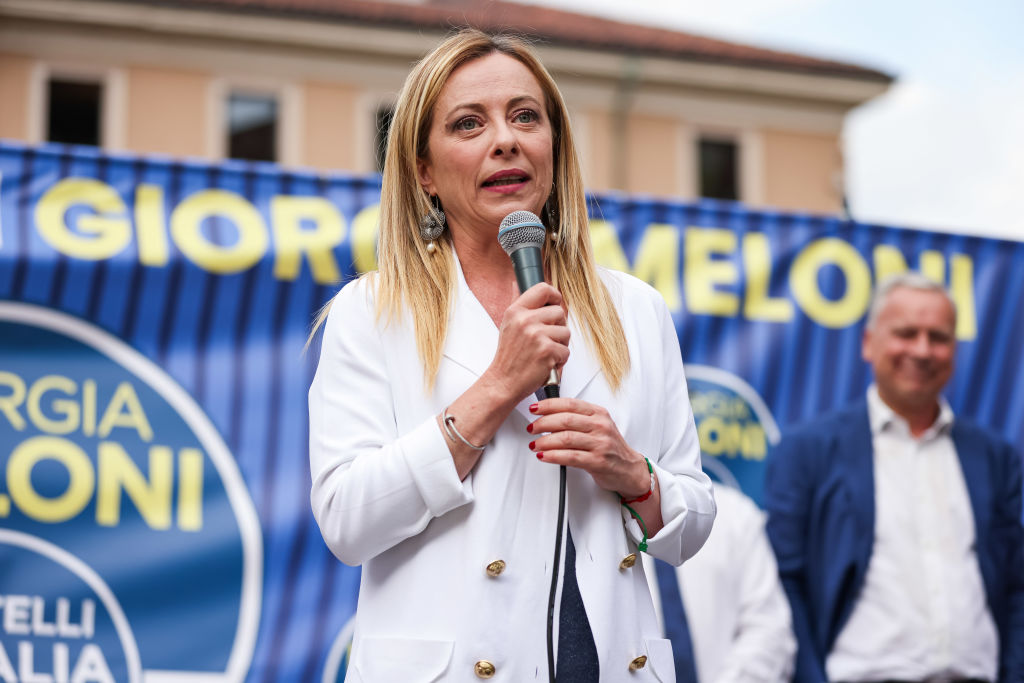
Fratelli D’Italia party leader Giorgia Meloni attends a rally for the elections in Piazza Roma on May 30, 2022 in Monza, Italy. (Alessandro Bremec / NurPhoto via Getty Images)
For most of the last week, Italian media was immersed in speculation on whether Mario Draghi wanted to remain prime minister — with some outlets almost begging him to do so. Even before his appointment as head of government in February 2021, the ex-European Central Bank chief was widely painted in both domestic and international media as the “Super Mario” who would “save Italy like he saved the euro.” In Italian centrist outlets, this praise never wavered, and in his final days in office, there were even some (very small) street protests to call for him to stay on. For the most sycophantic, Draghi was “the prime minister Italy needs, not the one it deserves.”
Addressing the Senate ahead of a confidence vote on Wednesday, Draghi explicitly referred to this “unprecedented mobilization” in his support. There had been quite a lineup of well-wishers: letters by bishops, doctors, university rectors, industrialists, cooperatives, and trade unions — added to a call backed by well over a thousand mayors. Why imperil the disbursement of European recovery funds, at a moment of continued turmoil? Yet it was hard to credit the idea that “the country had spoken.” After all, the core demand of the minority who did speak up was to maintain a government with no popular mandate, rather than risk snap elections.
Italian prime ministers are never directly elected by the public — and Draghi has never been elected to any role at all. His so-called “national unity” government bore no reference to the coalitions that ran in the last general election in 2018. This was, Draghi noted in his address, a reason why his administration necessarily had to be broad-based, rather than rely on a simple majority of parliamentarians. Yet his speech was hardly well-designed to improve relations with the parties who kept him in office, including the rump Five Star Movement (M5S) and the hard-right Lega. Criticizing these latter for obsessing about their own narrow agendas, Draghi asserted his own mission while claiming to stand above the fray of party politics.