Airbrushing Italy’s Fascist Past Is Helping Today’s Far Right
For three decades, revisionists have systematically turned Italy’s discussion of World War II away from Fascist crimes and toward the Italians killed by anti-fascist partisans. The effect has been to trivialize the Fascist past — and legitimize a new far right.
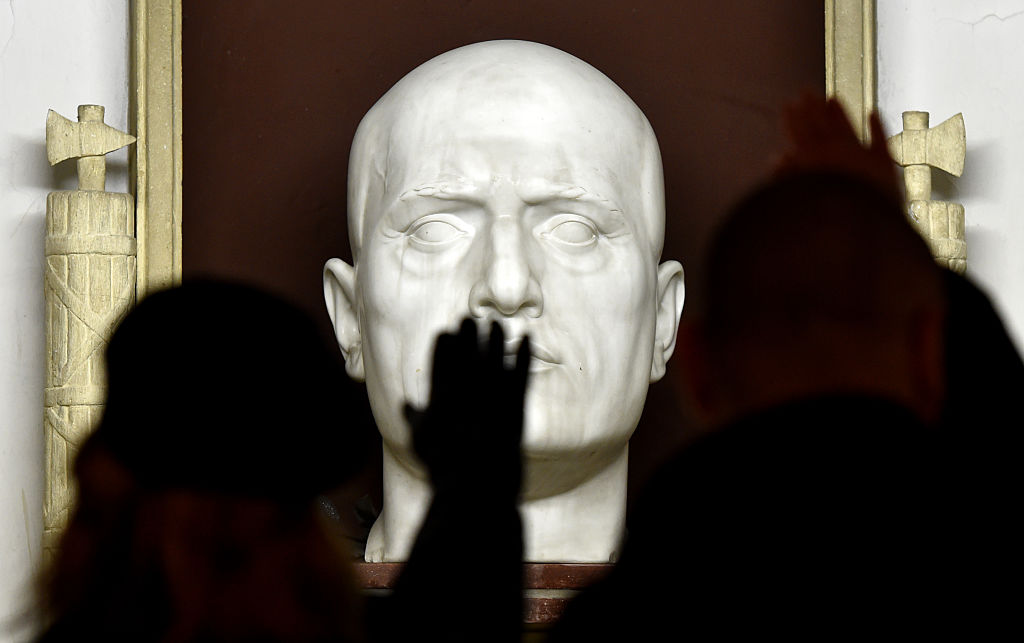
Far-right militants make the fascist salute (Roman salute) in front of the tomb of Italian dictator Benito Mussolini in Predappio, Italy on April 24, 2016. (Tiziana Fabi / AFP via Getty Images)
Front-runner for September’s Italian general election, Giorgia Meloni, this month insisted that “fascism has been consigned to history.” Such a statement was hardly a fulsome condemnation of the past; and the fact that she even needed to say it also shows that it is not really true. Benito Mussolini’s regime is not coming back, but attitudes toward the Fascist past remain a defining feature of Italian politics.
Especially important, in this sense, is the political turn of the last three decades. In the Republic founded after the Resistance of 1943–45, anti-fascism long held sway. Yet the major parties of the Resistance collapsed in the early 1990s, and in more recent times an aggressive revisionism has challenged anti-fascism’s moral superiority — emphasizing that there were crimes and victims “on both sides.”
Yet even this attempt to put the sides on an equal footing is married with clearly indulgent claims about the Fascist past, from Italy’s colonial wars to the “victims of communism” in World War II. Center-right pundits openly claim that “Mussolini did good things, too” and that the Resistance was a totalitarian plot. Today, a country unable to critically confront its past looks increasingly prey to a resentful nationalism.