When Australia Experienced a Mass Shooting, the Government Enacted Gun Reform
When 35 people were murdered by a lone gunman in Tasmania in 1996, the conservative government did something the American government hasn't: it quickly banned automatic and semiautomatic weapons.
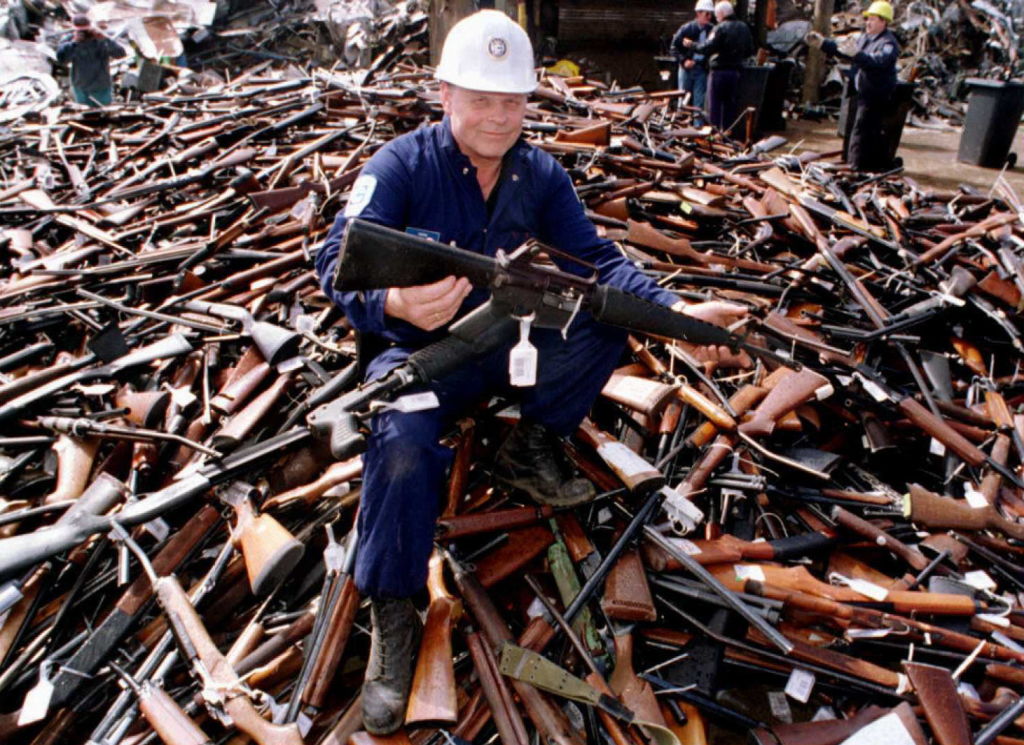
A man holds up a rifle similar to the one used in the Port Arthur massacre during a gun buyback in Melbourne, September 8, 1996. (WILLIAM WEST/AFP via Getty Images)
In the wake of mass shootings like those in Uvalde and Chicago, and in the absence of meaningful reform on gun control, Australia’s gun regulation is often pointed to as a successful example of a state willing and able to take real action. In 1996, thirty-five people were murdered by a lone gunman in Port Arthur, Tasmania. Newly elected conservative prime minister John Howard used the horrendous incident to push through a welcome new set of national guidelines on firearms.
Gun violence subsequently decreased in Australia. As a result, Howard is often painted as a brave leader who defied the gun lobby and his own constituents, reduced the number of guns in Australia, and ended mass shootings. The more nuanced versions of this narrative caution that this result is not set in stone. The simple lesson to be drawn is presumably that gun control is possible, even on right-wing terms.
Concrete gun control measures that reduce violence and suffering are of course welcome. But any simple celebration of Howard for introducing these measures misses much of the point. For one, the fall in gun violence needs to be attributed to broader causes, including the tireless feminist activism that has taken place over decades. Second, gun violence persists in the form of an increasingly powerful weapons industry, the growing militarization of the police, and increasing racist shootings of Aboriginal people. While mass gun violence involving strangers has more or less disappeared from mainland Australia, more meaningful reform is required to deal with the scale of the problem.