The Experiment
Italy’s Five Star Movement offers a hollow promise of democracy.
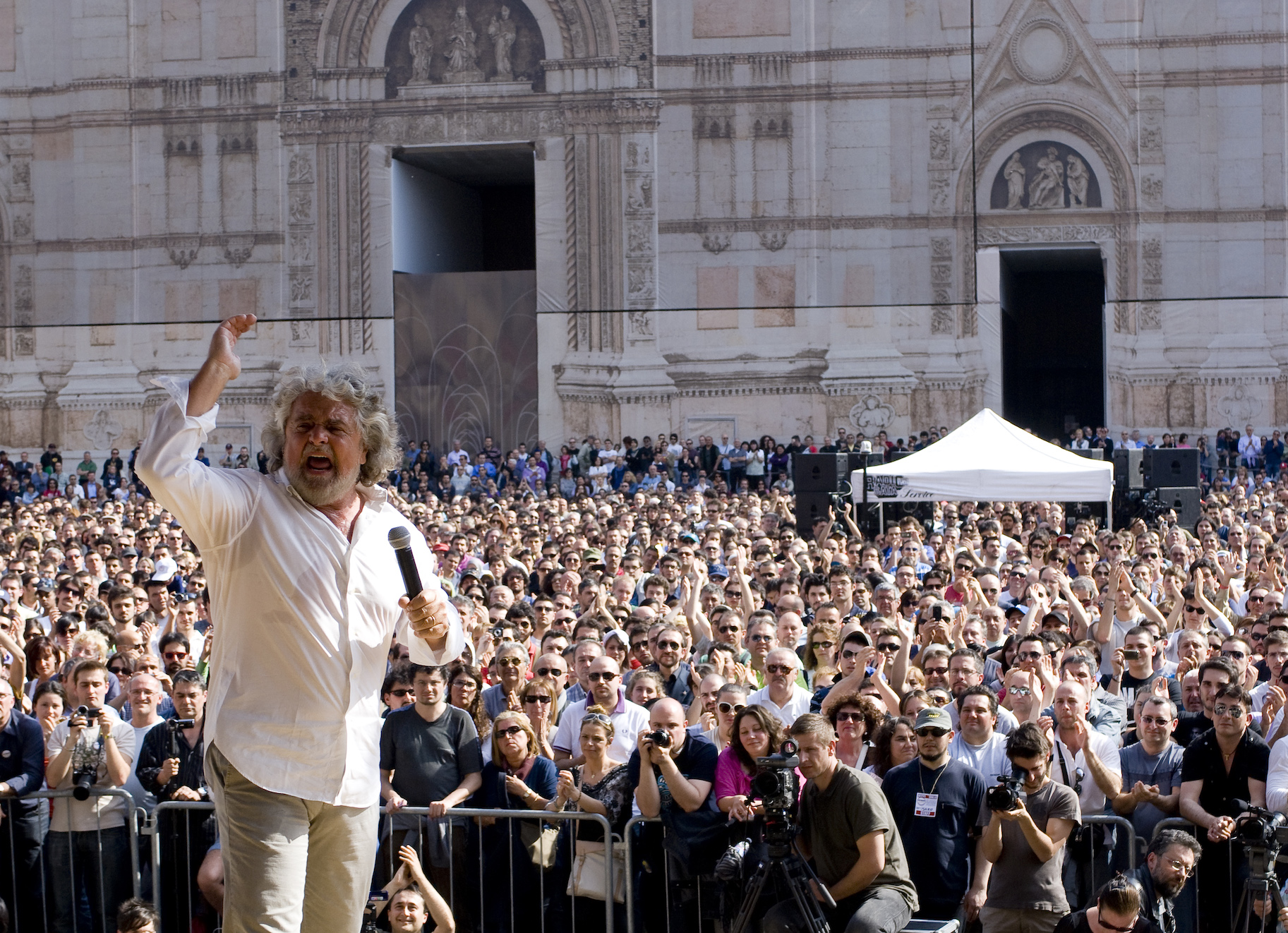
Five Star Movement leader Beppe Grillo speaks in 2011. Giovanni Favia / Flickr
In the run-up to Sunday’s Italian election, the Five Star Movement is the country’s largest single party. While the coalition arithmetic looks likely to block its path to government, since 2007 the M5S has seized a central role in Italian politics. It today holds the Rome mayoralty and stands close to 30 percent support.
Despite its opposition to “the caste” — an establishment ranging from politicians to journalists and European institutions — the M5S is difficult to define politically. If its galvanizing idea is its online direct democracy, standing in apparent contrast to Italy’s sclerotic institutions, it has not clearly assumed a collective identity.
Media often compares M5S to more clearly defined forces, such as Spain’s left-populist Podemos, or else emphasizes its connection to far-right and Eurosceptic forces. In reality, the M5S’s peculiarity lies in its bid to avoid such definition, thus remaining “intact” as a force defined against politics itself.