No, Post-Nazi Germany Isn’t a Model of Atoning for the Past
German public debate is often marked by self-congratulation at “coming to terms” with the country’s past. Yet comparisons between antisemitism and other racisms are increasingly being demonized — and it’s stifling discussion of Germany’s colonial crimes.
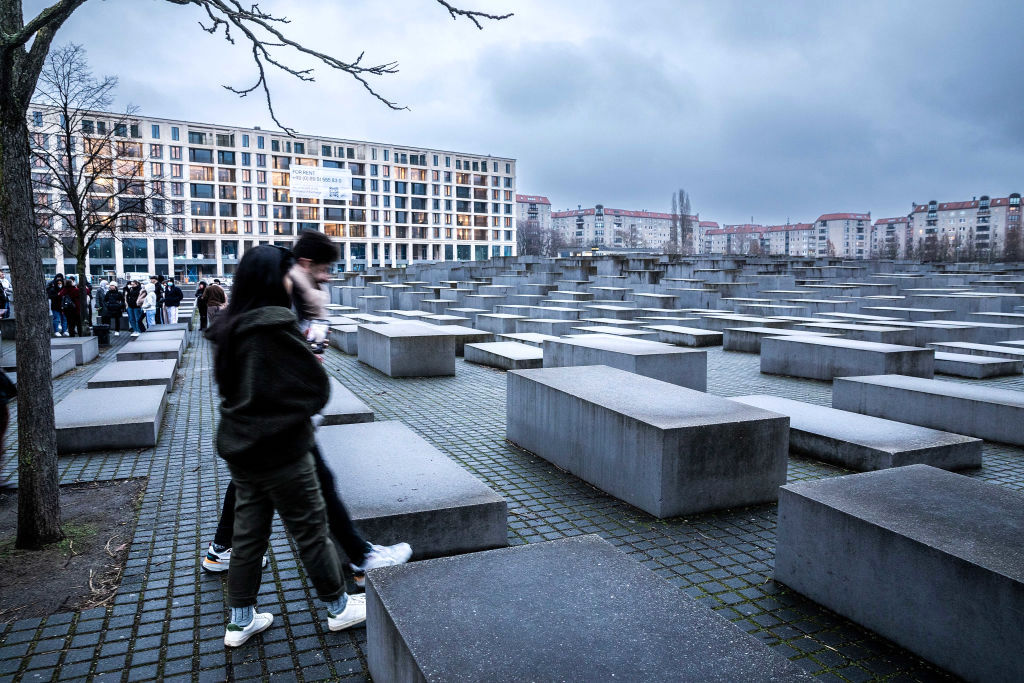
People walk through the Memorial to the Murdered Jews of Europe in Berlin, Germany. (Carsten Koall / picture alliance via Getty Images)
A new “historians’ dispute” (Historikerstreit) about the Holocaust is currently shaking Germany. The first took place over thirty-five years ago, during the Cold War, when the country was still divided and many players had firsthand experience of Nazism and World War II. Against the neoconservative historian Ernst Nolte, who deplored Germany’s imprisonment within “a past that will not pass,” the critical theorist Jürgen Habermas affirmed memory of the Holocaust as a pillar of German historical consciousness.
Undeniably, Nolte’s apologetic interpretation of Auschwitz as a simple “copy” of the Gulag — the Bolshevik crimes being the “logical and factual prius” of modern totalitarianism, and the Nazi ones the reaction of a threatened country — could fulfill a political function during the Cold War. In the twenty-first century, however, it has become useless, even for neoconservatives. Germany belongs to the West no longer as a geopolitical outpost in a bipolar world, but rather as one of its key actors, including as the motor of the European Union.
Created as the result of a long, twisted, and tormented process of “working through the past,” the Holocaust Memorial today at the heart of Berlin is doubtless an impressive material testimony to the integration of Nazism into German historical self-representation. Nonetheless, it also fulfills other purposes. Thanks to this successful “coming to terms with the past” (Vergangenheitsbewältigung), Germany is finally equipped to assume the leadership of the EU; for even beyond its economic hegemony, it has its cards in order also from the human rights viewpoint. Holocaust memory is no longer, as it perhaps was in Nolte’s days, the permanent and impossible work of mourning of a country facing its troubled past. Today it has become the sign of a new political normativity: market society, liberal democracy, and (selective) defense of human rights.