More Workers Are Quitting Their Jobs in Red States With Low Union Rates
Talk of the “Great Resignation“ is everywhere. But a close look at the numbers reveals something interesting: more workers are quitting their jobs in Trump-voting states with low unionization rates than in states with high unionization rates that rejected Trump.

Quit rates are higher in states with the lowest union density and lower in states with higher union density. (Audtakorn Sutarmjam / EyeEm / Getty Images)
I’m not sure what this means, but quit rates are higher in states that voted for Trump, and are higher in states with low unionization rates.
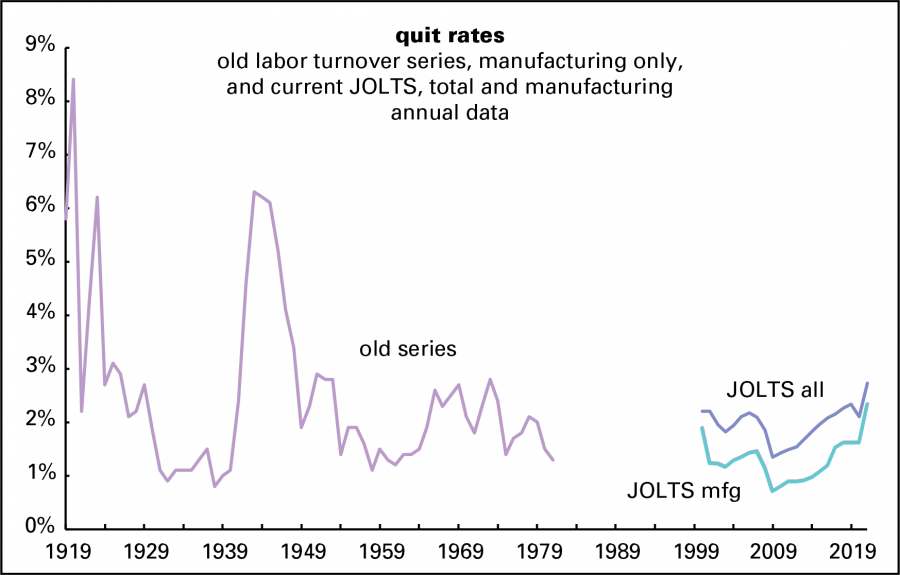
We’ve been hearing for some time now that quit rates are the highest on record. That’s true if you look only at the Job Openings and Labor Market Turnover Survey (JOLTS) numbers, which the Bureau of Labor Statistics (BLS) started reporting in December 2000. It had an ancestor, which the BLS reported for manufacturing only, covering 1919 to 1981 (left portion of the graph below). Current quit rates now are comparable to those of the 1960s and 1970s, and are well below peaks of the 1920s and 1940s. Much of the JOLTS history (right portion of graph below) covers, other measures show, an unusually torpid period for the US job market, so today’s levels may only mark a return to once-familiar territory.