How the Communist Party of Australia Built a Mass Movement
Though little discussed today, Australian communism was a movement that changed the lives of its members — and the course of national history.
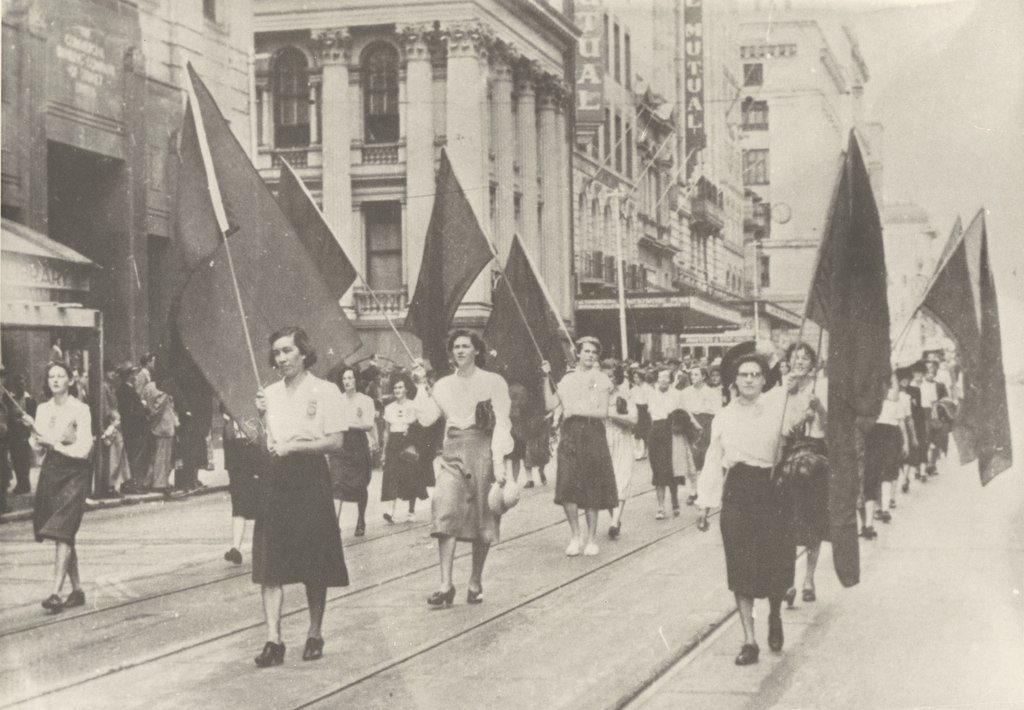
Communist Party of Australia members marching on May Day, 1944, in Brisbane, Queensland, Australia. (Constance Healy / Wikimedia Commons)
“Communism was a political movement like no other.” This is the opening line of The Party, the second volume of the late Stuart Macintyre’s history of Australian communism, which picks up in the late 1930s, where volume one, The Reds left off.
Macintyre’s observation is a fact all too easily forgotten today. For much of the twentieth century, communism was a global movement, with branches in almost every nation, that sought to do away with the present state of things. It demanded and inspired unswerving loyalty from its members, who built a counterculture embracing almost every aspect of their lives. In this way, communist parties were unlike typical bourgeois parties, who extend politics only to elections and stakeholder management.
Indeed, for most leftists today, Macintyre’s account will come as a revelation. For example, Macintyre quotes Hall Alexander, an electrician, who joined the Communist Party of Australia (CPA) in the 1940s and remained a member until the bitter end. As Alexander explains, he joined