American Police Have Always Been Militarized
The new documentary film Riotsville, USA enriches our understanding of technologically enhanced police militarism in the United States. But militarization itself is not a 20th-century evolution in policing — it’s been there all along.
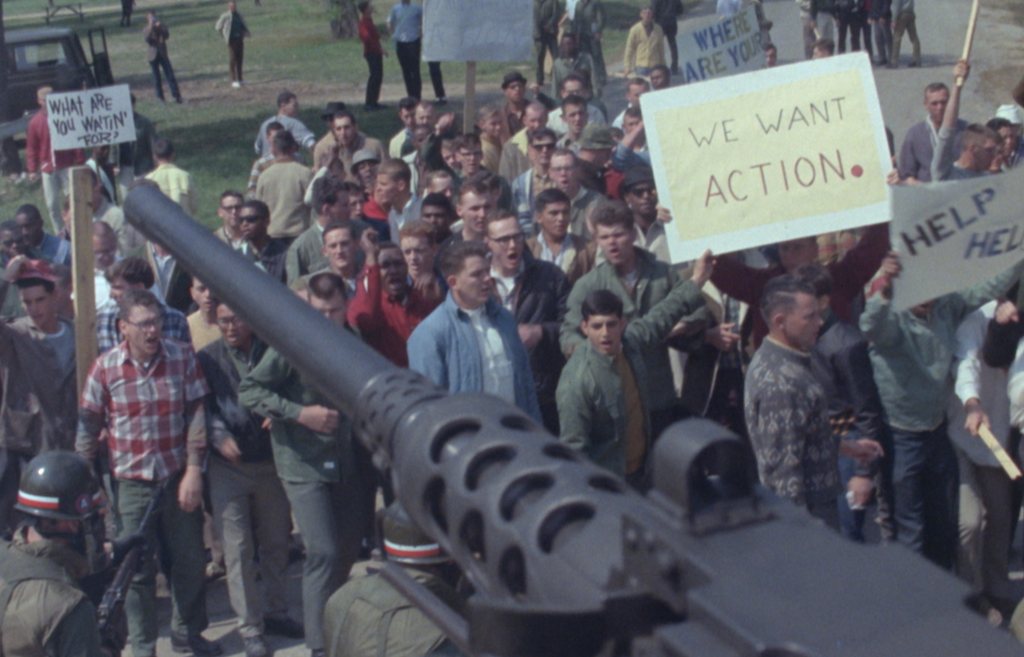
Still from footage in Riotsville USA.
In June 1882, a Boston lawyer noticed a man named John Burns leaning against a lamppost in Beacon Hill. Burns was drunk, but seemingly harmless, when a Boston police officer approached him from behind and knocked him “prostrate into the street” with a club to the head. The particulars of the case were quickly lost in a tangle of competing narratives. Was Burns disorderly and resisting arrest, or were these fabrications to cover up yet another instance of indiscriminate police clubbing?
News stories like these were standard fare in the late nineteenth century, but this particular instance prompted one writer at the Boston Globe to reflect on the material culture of the police. Alongside new vice laws, the Boston Police in 1882 acquired “handsome helmets” and “increased efficiency . . . by the introduction of stripes upon the coat sleeves.” The very notion of uniformed police in the nineteenth century often invited comparison to a standing army, which people from a broad cross section of American society commonly perceived as an affront to their democratic sentiments. At least in northern cities, police power in the 1880s was as contested as it was presumed, although the rhetoric of law and order would prevail in the coming decades.
This Boston Globe columnist continued that the police had been attending regular drills “in club exercise, superintended by the military member, familiarizing the men with the use of their weapons.” We know that military drills were common in this period, as in New York City where Commissioner Abram Duryée was “something of a fanatic with regard to the military nature of police work . . . fond of drilling the force to the point of exhaustion.” The militarism of early American policing was even clearer in the case of eighteenth-century slave patrols and urban city guards — the latter of which, Frederick Law Olmstead observed when visiting Charleston in 1860, deployed “police machinery as you never find in towns under free governments.”