Yolanda Díaz Is Fighting to Make the Spanish Left Work
Since becoming Unidas Podemos leader last April, Spanish labor minister Yolanda Díaz has broken the populist party out of its rut. She’s won concrete gains for organized labor through her government post — showing how the Left can reconnect with the working class.
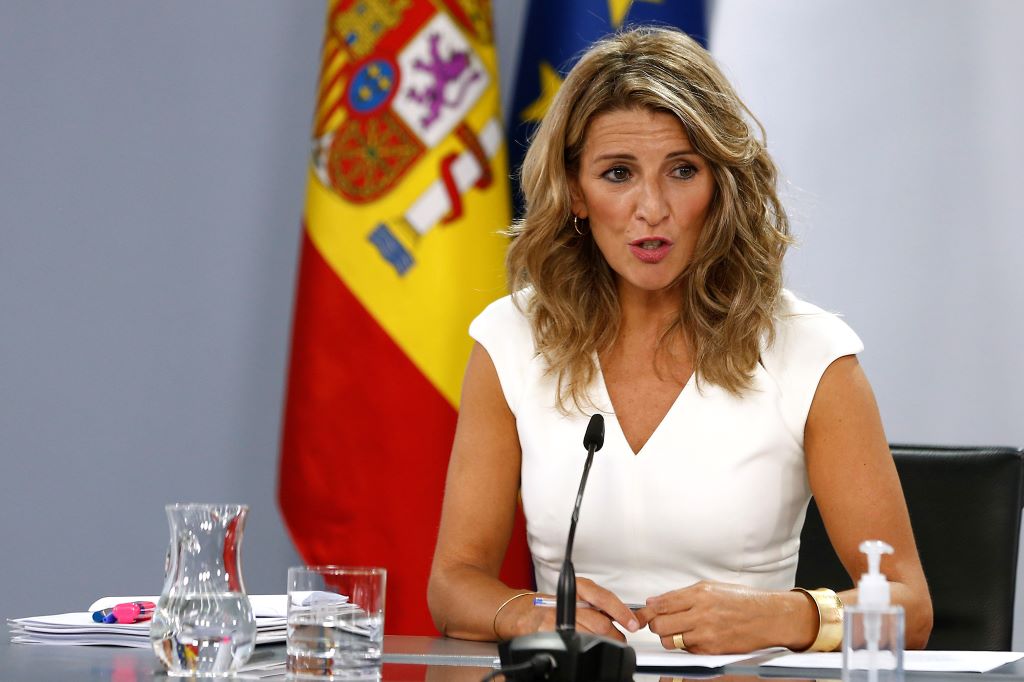
Yolanda Díaz, second deputy prime minister of Spain and a lifelong member of the Spanish Communist Party, has rapidly ascended to become the Spanish left’s new figurehead.
When Pope Francis granted Spain’s left-wing deputy prime minister Yolanda Díaz an official audience before Christmas, the opposition Partido Popular branded the meeting a “communist summit.” It seems that even for the mainstream right, the head of the Catholic Church is now part of the “anti-Spain” bloc determined to undermine the nation. Francis had already come under attack last September when he apologized for the Church’s role in the Spanish conquest of the Americas; his meeting with Díaz, a lifelong member of the Communist Party of Spain (Partido Comunista de España, PCE), only reinforced the Right’s animosity.
In truth, the meeting provided greater headaches for center-left prime minister Pedro Sánchez and his governing Spanish Socialist Workers’ Party (Partido Socialista Obrero Español, PSOE). Since she took over as head of Unidas Podemos (the junior partner in Spain’s progressive coalition) last April, Díaz has gained increased national prominence, with recent polling showing her overtake Sánchez to become Spain’s most popular political leader. Nearly one-fifth of 2019 PSOE voters now prefer her to lead the next government.
In this context, the papal audience was a propaganda coup — allowing Díaz to project the image of a national leader, and one capable of reaching out well beyond the far-left electorate. It also underlined how much her rapid ascent as the Spanish left’s new figurehead has depended on her institutional profile, first as labor minister and then as one of the three deputy prime ministers. In contrast to her predecessor Pablo Iglesias and other left-populist leaders across Europe, Díaz has become a household name not primarily as an anti-establishment outsider vowing a break with the existing political system but as a government minister seeking to guarantee the rights and income of working people during the pandemic.