Portugal’s Election Will Decide If Working People Really Benefit From the Recovery
Today Portugal votes in snap elections, as prime minister António Costa seeks to end his center-left government’s reliance on far-left parties. If he succeeds, it will commit Portugal even further to a failed low-wage, low-investment model.
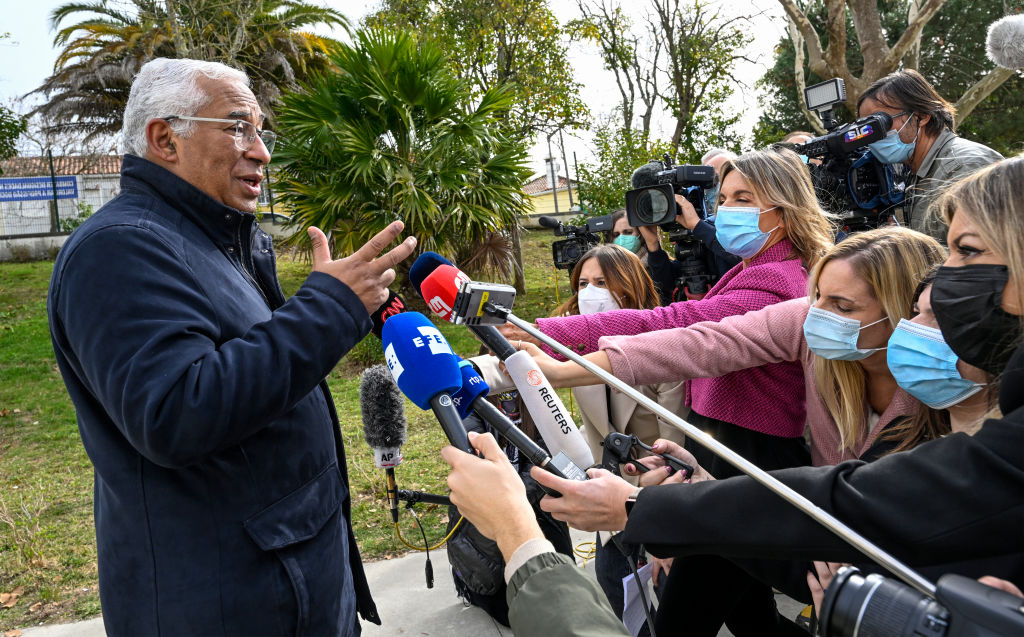
Portuguese prime minister António Costa speaks with journalists while waiting for his wife to cast her ballot in today’s snap elections. (Horacio Villalobos / Corbis via Getty Images)
After two years of pandemic conditions, leaders across Europe are holding on to their positions as if to dear life. The first to go was Italian prime minister Giuseppe Conte, who buckled under pressure last February, handing over the reins to the technocrat Mario Draghi. In Germany, Angela Merkel’s long-awaited departure brought a swing to the center left. In Britain, Boris Johnson faces mounting calls to resign following a steady stream of revelations about parties held in his residence during lockdown.
But what no European politician even thought of doing was risk a snap election, in the belief that, despite current unknowns and adversities, they would amass a thumping majority. None, that is, bar Portuguese prime minister António Costa. Today he will find out whether his gamble has paid off — and if he has improved upon the 36 percent his party achieved in the last such contest in October 2019, shortly before COVID-19 hit.
The move can’t simply be explained as some sort of megalomaniac bout of confidence. Rather, Costa had material reasons to believe this was a smart political maneuver when the opportunity presented itself. His Socialist Party (Partido Socialista, PS) had ruled as a minority government since 2019, following four years in which he depended on a governmental agreement with the far left. This was a victory for PS, which for the last two years has thus been free to tack between passing progressive laws with the support of the Left Bloc (Bloco de Esquerda, BE) and the Communist Party (Partido Comunista Português, PCP), or else more conservative policies with the help of the center.