Pablo Iglesias: The Left Needs to Break the Reactionary Stranglehold Over the Spanish State
- David Broder
In Spain, a center-left coalition government faces opposition not just from right-wingers and business leaders but from parts of the judiciary and police. For Pablo Iglesias, it’s time the Left pushed back against right-wing dominance in the state machine.
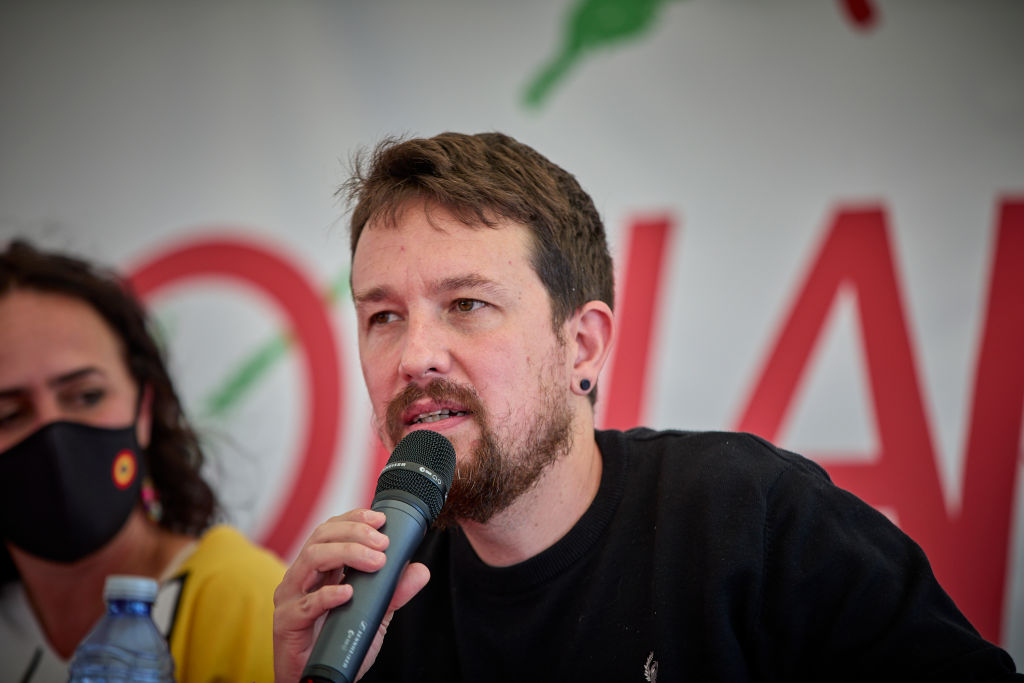
Podemos leader Pablo Iglesias speaks at the centenary celebration of the Communist Party of Spain in Madrid, Spain, on September 25, 2021. (Jesus Hellin / Europa Press via Getty Images)
Karl Marx and Friedrich Engels wrote in the Communist Manifesto that the state is fundamentally a committee for managing the affairs of the bourgeoisie. This notion of the state as the administrative expression of that class’s economic interests doubtless responded to the historical reality of the time. Later, in one of his most influential texts, The Eighteenth Brumaire of Louis Bonaparte, Marx would distinguish between political power (which he identified with the state) and economic power. Not even the conquest of political power ensured domination over economic power.
With the development of Europe’s welfare states in the second half of the twentieth century, many Marxists began to understand that the state, while retaining many of its traditional administrative and political functions, was also a terrain of political combat. Nicos Poulantzas obviously stands out among these. For the Greek theorist, the political successes of the Italian workers’ movement, as crystallized in the 1970 Workers’ Statute, were proof that the state and the law were one of the terrains of class struggle and working-class advance. The statute achieved in Italy strengthened the trade unions in the factories, prohibited dismissal without just cause, and guaranteed freedom of assembly. The state appeared, in fact, not only as a terrain of class struggle just as important as or even more important than the factory, but also as a strategic political field.
The emergence of neoliberalism only confirmed the paradox. Faced with the offensive waged by economic powers attached to neoliberalism, workers found tools of political resistance in postwar constitutions and the labor law enacted by welfare states.