In Germany’s Election, the Center Can Hold
Next Sunday’s German election is one of the most unpredictable in decades. But even if Olaf Scholz’s Social Democrats do pull off an upset victory, they’re promising continuity with Angela Merkel’s policies — not the change working people need.
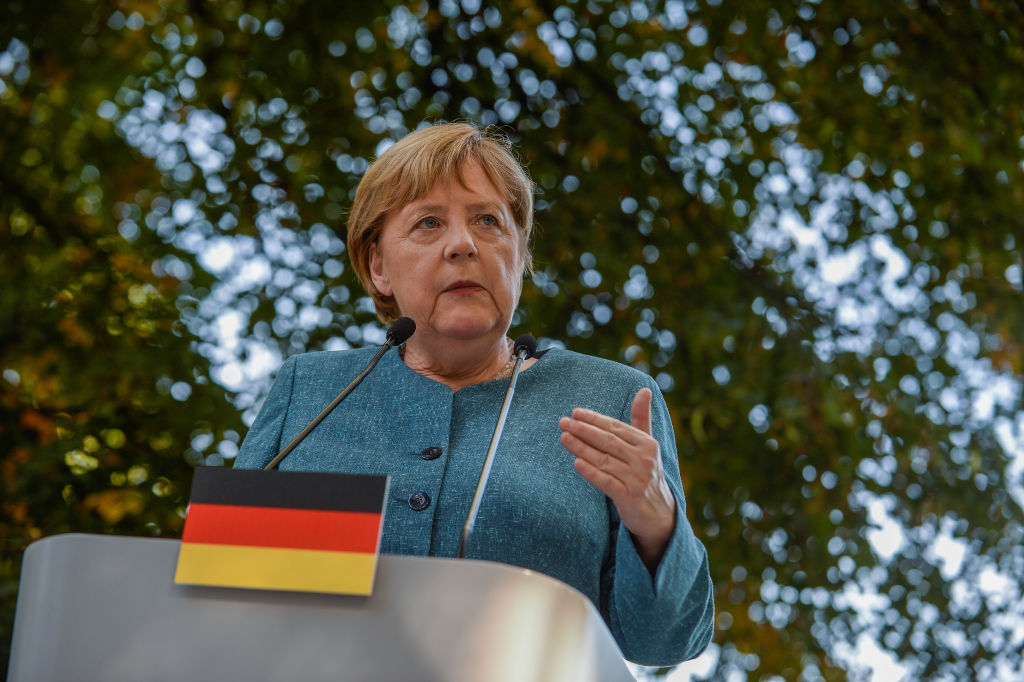
Whichever coalition replaces Angela Merkel’s government in next Sunday’s election, chances are it will pursue another four years of Merkelism. (Omar Marques / Getty Images)
When Angela Merkel finishes up her fourth and final term as German chancellor next week, it really will mark the end of an era. Though not the country’s longest-serving head of government (an honor still reserved for founding father Otto von Bismarck), Merkel’s reign was remarkable. Her sixteen years in office saw a sweeping consolidation of Germany’s economic and political might, firmly establishing it as the paramount power in the European Union. This ascent within the EU was accompanied by near-continuous economic growth at home — boosted by the low-wage sector created by previous chancellor Gerhard Schröder’s neoliberal reforms.
While much of Europe struggled to recover from the 2008 financial crisis, German GDP recovered its losses by mid-2011 and has posted consistent quarterly growth numbers ever since. Social inequality has also risen considerably — Germany now has twice as many billionaires as it did when the Christian Democrat (CDU) leader Merkel was first elected in 2005 — but many voters don’t seem to mind. Just days before she steps down, nearly two-thirds of Germans say they are “satisfied” with her performance. Wages might be stagnant, but at least there are stable jobs to be had and a federal state that, so far, appears capable of dealing with crises (of which there have been plenty). Rent has grown unaffordable in many urban areas, but the government still subsidizes plenty of ways for families to build a house in the suburbs. In short: things could be a lot worse.
The explanation for Merkel’s apparent success is simple. She gave German voters what they value more than anything else: stability. The CDU has always integrated some workers into its coalition, particularly those from rural areas and small workplaces without unions. But, under Merkel, the party became a big-tent party par excellence. After receiving a poorer-than-expected result in 2005, Merkel pivoted to the center, backed away from further labor-market reforms, and spent most of the last sixteen years governing with the Social Democrats (SPD). Her tenure has seen a number of comparatively progressive reforms, including the legalization of gay marriage and the institution of a minimum wage. Though her CDU remains a party of middle-class professionals and capitalists both large and small, under Merkel at least it was able to expand its coalition to include many working-class voters who wanted stable governance and a stable economy.