A “Red-Red-Green” Coalition in Germany: A Nice Idea, But Not Very Likely
With the announcement that Olaf Scholz will lead Germany’s SPD into the 2021 elections, chances for a revival of social democracy in the heart of Europe appear grim. But prospects for the radical-left Die Linke aren’t looking much better, either — stalling hopes of a break with Christian Democratic dominance.
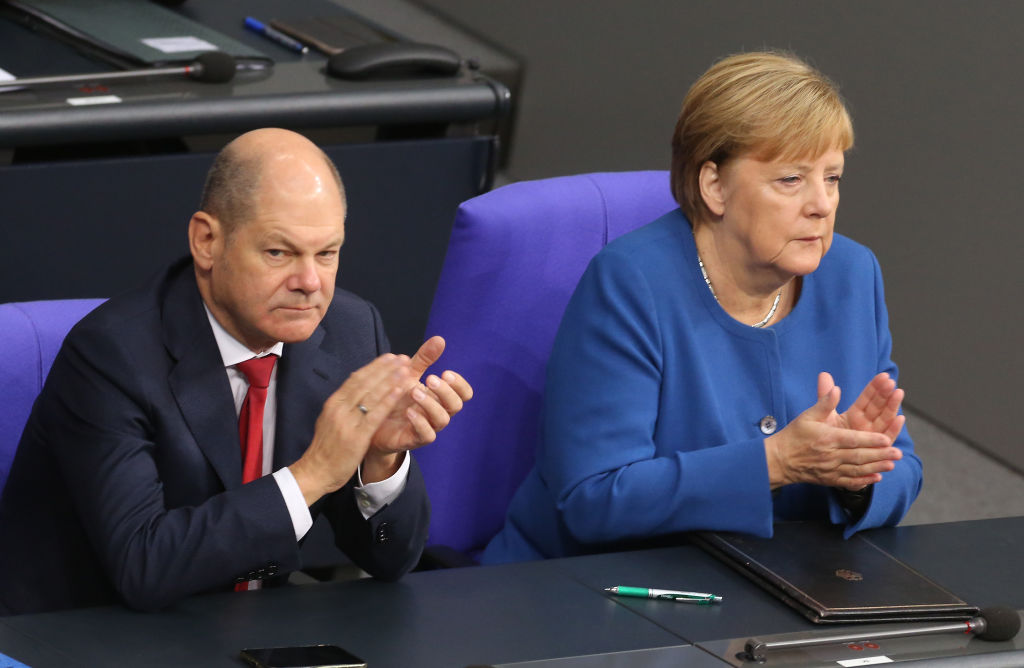
German chancellor Angela Merkel applauds as she waits next to finance minister and vice chancellor Olaf Scholz (SPD) prior to speaking to Bundestag members in the Reichstag, the seat of the country’s federal parliament, on October 17, 2019 in Berlin, Germany. (Adam Berry / Getty Images)
In December last year, Germany’s Social Democratic Party (SPD) elected a new, moderately left-wing leadership. This rare shift came in the wake of a chain of humiliating electoral defeats and a widespread sense that something had to change if the party were to survive — let alone remain a major political force. In a surprise turn for the country’s oldest political party, new co-chairs Saskia Esken and Norbert Walter-Borjans won a slim majority against the party establishment after pledging to shift course and return to the kinds of left-of-center policies it pursued well into the 1990s. They called for higher taxes, deeper European integration, and increased transparency and inner-party democracy to encourage grassroots activity.
With the SPD polling at record lows after over a decade as the junior partner in a coalition with Angela Merkel’s Christian Democrats (CDU), no one expected Esken and Walter-Borjans to resurrect its fortunes overnight. Neither the new leadership nor the wider membership was keen to leave the grand coalition with Merkel immediately, fearing that fresh elections would weaken the party even further. Crucially, however, they promised there would be no return to this coalition after the 2021 federal election — and strongly implied that a “red-red-green” government between themselves, the Greens, and Die Linke, along the lines of current city administration in Berlin, was their preferred option.
These statements represented the furthest an SPD leader had gone in terms of calling for a government of the Left on the national level — and understandably caused cautious excitement among German progressives of all stripes. This was particularly true of the more pragmatic currents of its left-wing rival, Die Linke, which has struggled to define its role in the political landscape and appears increasingly stagnant, with both membership as well as polling numbers seemingly frozen in place. A center-left majority in parliament and a willing SPD, many reasoned, could open the door to newfound political relevance and, perhaps, the chance to make concrete policy changes in Germany and perhaps even Europe as a whole. But now such optimism has been severely held in check.