Germany’s Left Has New Leadership but Not a Strategy
After years of stagnant poll numbers and declining electoral results, Germany's Die Linke party hopes that its new leadership team will return it to the promise of the 2000s. But as its social base in the former East fragments, the left-wing party doesn't just need a different marketing strategy — it needs to rebuild its roots in working-class life.
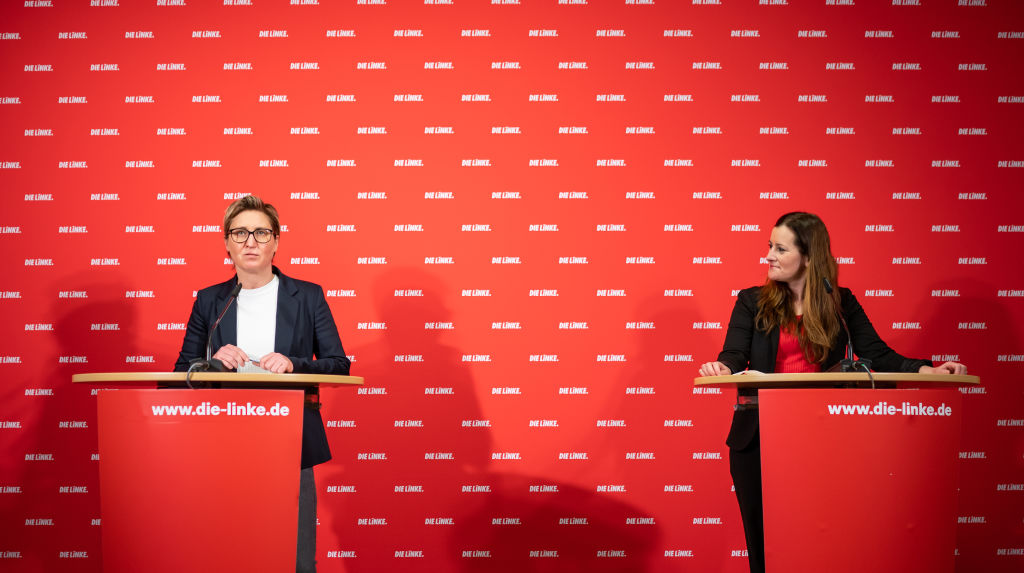
Susanne Hennig-Wellsow (L) and Janine Wissler (R), the new federal leaders of Die Linke, speak on current issues at a press conference in Berlin on March 1, 2021. (Bernd von Jutrczenka/picture alliance via Getty Images)
On February 27, Germany’s socialist party, Die Linke, finally held its much-delayed party congress. Janine Wissler, a rising star on the party’s left wing, and Susanne Hennig-Wellsow, party leader in Thuringia, where Die Linke governs at the head of a center-left coalition, took over from long-serving party cochairs Bernd Riexinger and Katja Kipping.
Riexinger and Kipping’s nearly nine-year tenure was originally a marriage of convenience between the party’s nominal far left and a sizable chunk of its more moderate camp. They oversaw a degree of stabilization within the party, but also undeniable stagnation. Neither proved particularly charismatic or adept in the public eye, and repeatedly found their leadership challenged in the media by ex-parliamentary chair Sahra Wagenknecht, who launched an ill-fated attempt at a left-populist formation, Aufstehen, in 2018. Die Linke’s polling numbers have hovered between 6 and 9 percent for years, neither harmed by its own slipups nor able to capitalize on those of others — leading German weekly Der Spiegel to ask whether the party had grown “sclerotic.”
Wissler and Hennig-Wellsow are thus understandably being hailed as a chance at reviving the party’s fortunes. The online congress that elected them was remarkably tranquil compared to previous gatherings, with few open clashes and a general consensus that, with a string of state and federal elections scheduled for later this year, now is the time for unity and party-building. Yet for all the nods of agreement, the problem of what kind of party needs building remained rather vague.