WeWork Was the Embodiment of Silicon Valley’s Culture of Delusion
WeWork, the coworking start-up once valuated at $47 billion, was a cult masquerading as a company pretending to be a movement. Focusing on its “charismatic” CEO, Adam Neumann, a new Hulu documentary misses a chance to expose the irrationality and waste of an economic system that lets such charlatanism thrive.
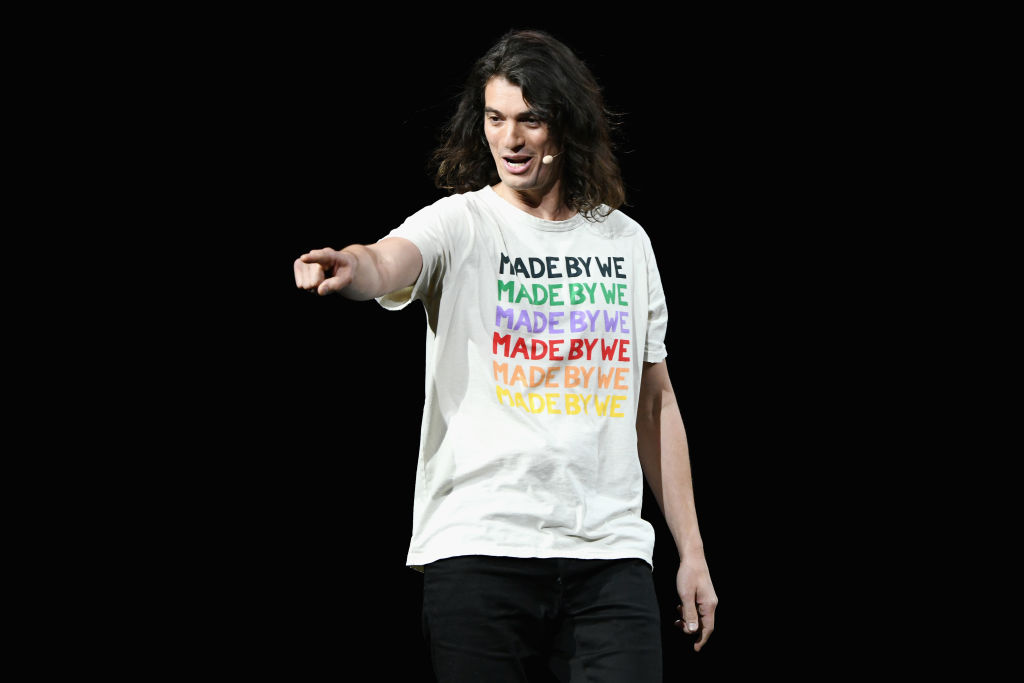
Adam Neumann, cofounder and then-CEO of WeWork, speaks onstage in Los Angeles in 2019. (Michael Kovac/Getty Images for WeWork)
In one latter-season episode of NBC’s The Office, the character of Ryan Howard (played by B. J. Novak) tries to get his coworkers to invest in a new venture called WUPHF.com. On its face, WUPHF (pronounced “woof”) doesn’t sound particularly revolutionary — its supposedly innovative promise being a service that spams every single one of a recipient’s social channels whenever a user sends out a message or text (and prints out a corresponding “wuphf” at the nearest available printer). In imagining WUPHF, the episode’s writer Aaron Shure was obviously taking a gentle dig at Silicon Valley start-up culture and the transparently silly ideas it so often produces.
Still, take even a cursory look at some of the high-profile corporate bullshit artists of the past decade and the degrees of difference separating Howard’s idiotic scheme from its real-world equivalents quickly begin to blur. Throw in some start-up cash, a reverential media hit or two, replace the meek Novak character with an MBA-wielding egomaniac, and it fast becomes quite easy to imagine WUPHF enjoying an Icarus-like ascent in the world of big tech, even if few people were ever actually inclined to use it. Elizabeth Holmes, after all, took the now defunct Theranos to a $9 billion valuation before it finally went under (the minor wrinkle in the company’s business strategy being that its widely touted blood-test technology never actually worked and was physically impossible). Billy McFarland established enough of a reputation as an up-and-coming entrepreneur that he successfully sold people on a music festival that didn’t really exist — similarly committing fraud along the way.
There’s plenty, of course, to distinguish the two cases. McFarland, for what it’s worth, never got anywhere near as rich as Holmes, and his business ideas were decidedly less ambitious than the proposed giant leap in medical technology on which she made her name. Nevertheless, Theranos and the Fyre Festival are both instructive case studies in how the now hegemonic culture of big tech can encourage quack enterprises unmoored from any productive function, innovation, or, in some cases, tangible results of any kind. They’re also textbook examples of the way certain entrepreneurial personalities can become so grossly overvalued that their mythos ultimately obscures reality itself.