In Albania, a New Left Is Challenging the Oligarchs’ Parties
Today’s Albanian election sees Edi Rama’s Partia Socialiste running for a third term, two years after a powerful student movement forced the sacking of half his cabinet. In one of Europe’s poorest countries, green shoots of protest are finally challenging the parties that led Albania to neoliberal capitalism.
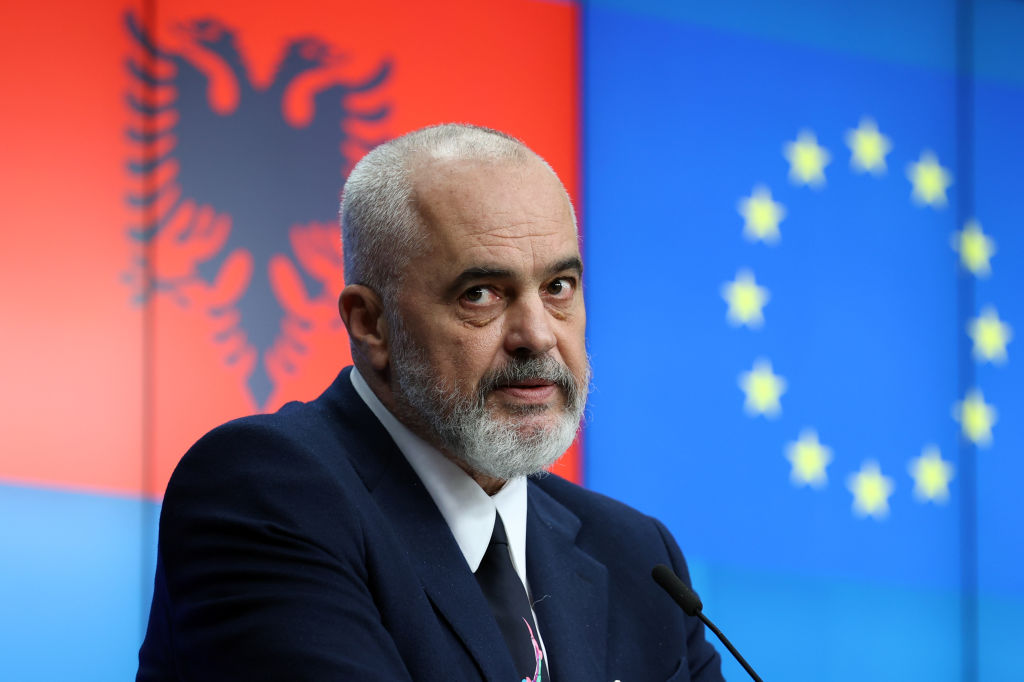
Prime minister of Albania Edi Rama in Brussels, Belgium, on March 1, 2021. (Dursun Aydemir / Anadolu Agency via Getty Images)
Today’s parliamentary elections in Albania will see the PS (Partia Socialiste) aiming for a third term in office, with the rival PD (Partia Demokratike) seeking a return to power after eight years in opposition. This follows a pattern: the three decades since the end of the Hoxhaist regime in 1991 have seen these two parties alternate in government, leading the country from a planned economy toward the free market.
In the early years following the collapse of the dictatorship, the main economic and financial reforms promoted by both main parties consisted of stabilizing the currency, privatizing state-run enterprises, and opening the market to foreign investors. This soon hit trouble: the failure of Ponzi schemes in 1997 prompted a near-civil-war situation.
But over the last two decades, the Albanian economy has been relatively stable, with GDP growth peaking at 4.1 percent in 2018, albeit falling back the following year due to a series of both natural and governmental disasters. Unemployment figures are, however, still high and volatile — even the low of 12.3 percent reached in 2018 was considerably higher than the average for EU countries.