Living on Poverty Wages Means Living on a Razor’s Edge
We spoke with Fight for $15 activist Terrence Wise, who recently testified before the Senate Budget Committee, about life on low wages, the rhythms of collective protest, and why the Biden administration will pay a price if it abandons its pledge to support the movement's central demand of a $15 minimum wage.
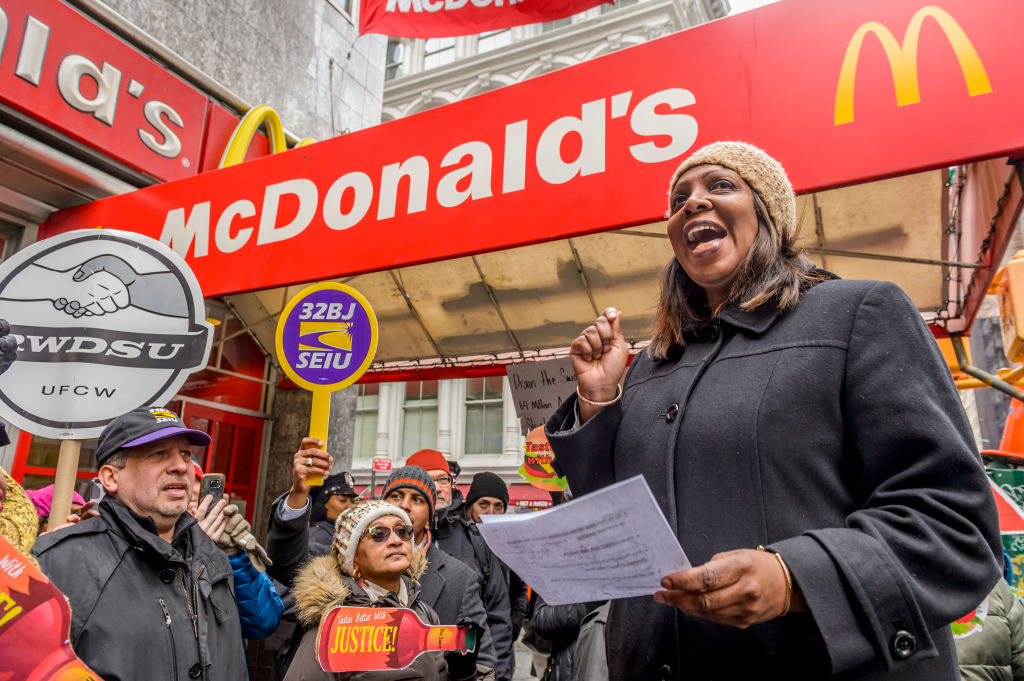
Several of workers participate in a Fight for $15 protest in front of a McDonald’s in New York City, 2017. (Erik McGregor / LightRocket via Getty Images)
Congress has passed a wide-ranging COVID-19 relief package, but one thing that is not included in the bill is an increase of the federal minimum wage. The current minimum is $7.25 an hour, and the last increase was in 2009.
One of the key sources of pressure to raise the wage has been the Fight for $15, which is a project backed by the Service Employees International Union (SEIU) aiming to raise wages and unionize fast-food workers. The movement began in 2012, and while it has won $15 minimum wages in several cities and states, its goal for a national $15 minimum remains unmet, and the prospect of unionizing the fast-food industry is still daunting.
As Congress was considering including a $15 minimum wage in the relief bill, Senate Budget Committee chairman Bernie Sanders held a hearing on wages. He invited CEOs — most of whom declined — and workers to testify before the committee. One person who accepted Sanders’s invitation was Terrence Wise, a McDonald’s worker, father of three, and leader in the Fight for $15. Wise told the committee of his childhood as the son of a fast-food worker: the money wasn’t enough to sustain the family, so he left high school to work full time in fast-food himself. He is still doing so, and still not making enough to get by. Even with his fiancé’s income as a home health care aide, his family was recently evicted, leaving them homeless during the pandemic.