The Tide of Feminist Organizing Is Rising in Chile
- Bree Busk
- Andrea Anderson
In recent years, the women’s strike in Chile has become a driving force in the broader fight for dignity and equality across society. As the country prepares to rewrite its constitution, feminist organizers want to steer the process toward deep social transformation.
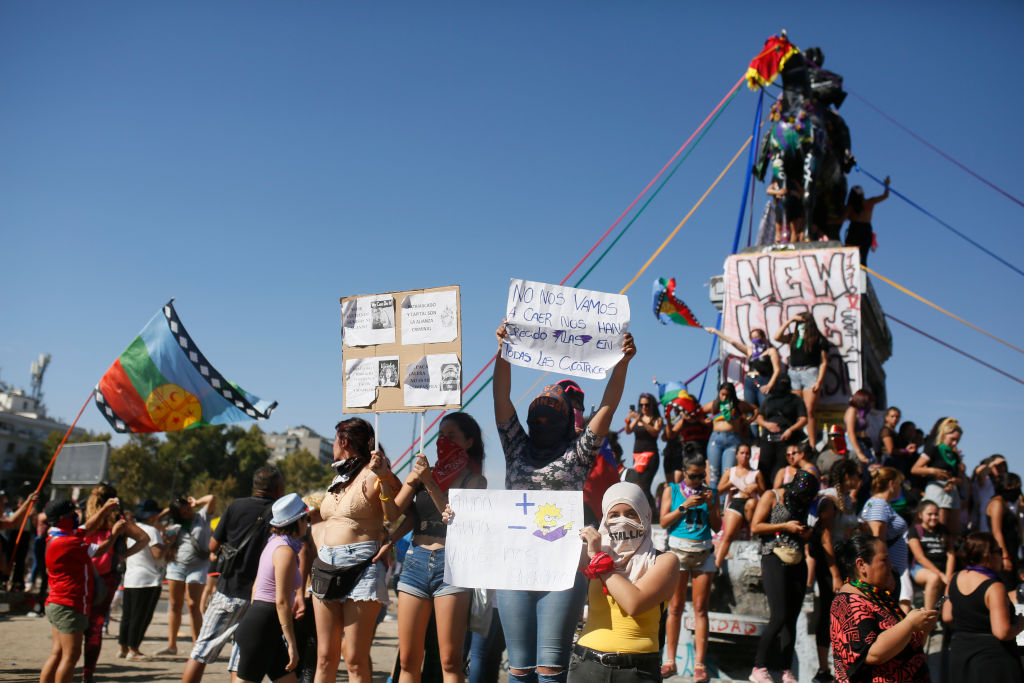
Women protest as part of the International Women’s Day at Plaza Baquedano on March 8, 2020 in Santiago, Chile. (Gaston Brito Miserocchi / Getty Images)
Karina Nohales and Alondra Carrillo are two of the most prominent members of the Chilean 8M Feminist Coordinating Committee (Coordinadora Feminista 8 de Marzo, or CF8M). The group, formed in the midst of Latin America’s powerful feminist wave, has become a leading presence on the Chilean left, especially after the revolts of October 2019 shook Chile to its core.
Speaking on behalf of CF8M, Karina and Alondra — and much of the Chilean left — have been critical of the Agreement for Social Peace and the New Constitution that was signed in November last year, in the wake of the preceding year’s uprisings. While formally initiating the process that would lead to the drafting of a new constitution, the agreement was regarded by some as a rearguard effort by President Sebastián Piñera and the Chilean political class to pacify street mobilizations, preserve the existing technocratic party structure, and provide a cloak of amnesty for human rights abuses committed in the midst of the uprisings.
Even with those misgivings, the results of the October 2020 plebiscite have drawn social movements like the CF8M into the heart of the constitutional process. The first takeaway from the vote held on October 25 was that the Chilean people — and perhaps even more significantly, a heavily working-class constituency — was in favor of scrapping the current constitution that dates back to the Pinochet dictatorship. Not only did upward of 80 percent of those voting — in record-number turnouts — favor the drafting of a new constitution, but they also preferred that the document be drawn up by a constitutional convention comprised of directly elected citizens and social movement activists. This unexpected turn of events led the once-skeptical social movements to embrace the constitutional process as a vital arena of social transformation.