Jeff Bezos: Your Legacy Is Exploitation
Jeff Bezos is stepping aside as Amazon's CEO having made a fortune of almost $200 billion. It's an attempt at reputation rehabilitation — but he can't escape the legacy of exploitation he leaves behind.
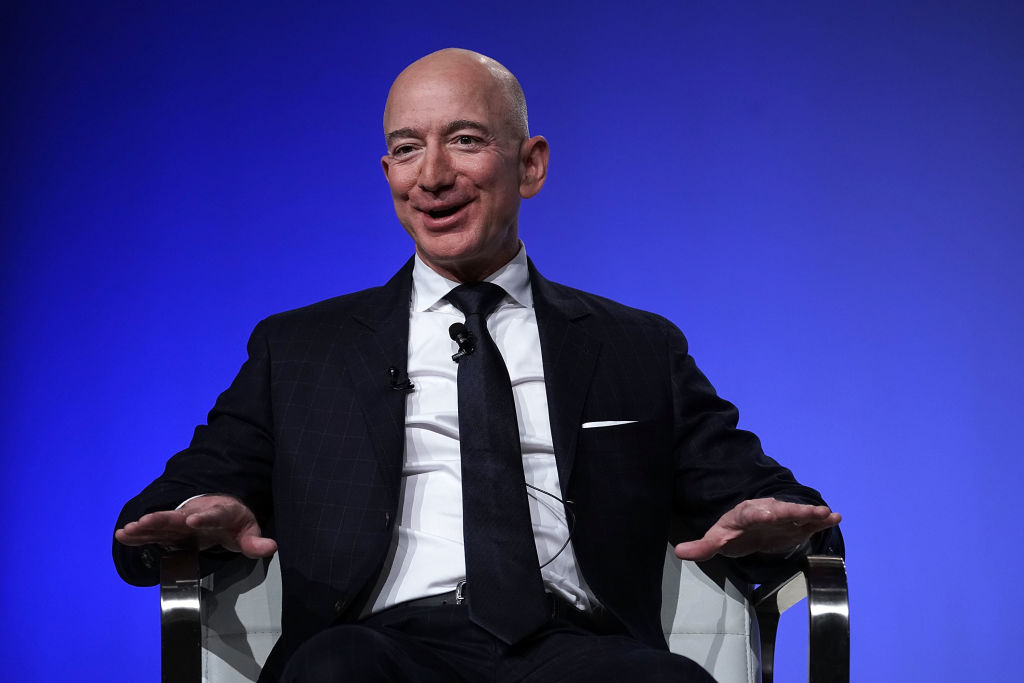
Jeff Bezos on September 19, 2018 in National Harbor, Maryland. (Alex Wong / Getty Images)
Jeff Bezos, who you might also know as “the richest man in the world” or “that guy who ate a lizard one time,” is stepping down as the CEO of Amazon after twenty-seven years at the helm — or maybe it’s better to say he’s stepping to the side. Bezos will instead take on the title of executive chair, which means he’ll still have an influential role in company decisions, but will no longer be the face of Amazon. Yet there’s no reason to believe that means Amazon will become the friendly monopolist its smiling logo might suggest.
With Bezos at the helm, Amazon grew from an online bookseller started from a garage in Bellevue, Washington to one of the largest publicly traded companies in the world that not only controls key e-commerce and cloud platforms, but has extended its reach into a growing number of sectors. However, it’s important not to get distracted by the triumphalist historicizing of tech companies and their chief executives that’s become far too common since internet businesses exploded in the 1990s.
It’s often said that Amazon was started in Washington so it would be close to Microsoft and try to attract some of its talent, and while that’s partly true, it was hardly the deciding factor. Before founding the company in 1994, Bezos was the senior vice president of a hedge fund, and it’s said he made sure the first house he rented in Bellevue had a garage so he could spin the kind of founding story one would expect of a tech company. He was hardly poor, and he knew how to minimize his tax burden.