Capitalism Is Not a “Free Labor” System
Apologists for capitalism like to point to its historically progressive aspects, like its supposed use of “free labor” rather than older forms of labor compulsion. But throughout its history, as the system has conquered new territories for capital accumulation, it has embraced and depended on the most coercive forms of “premodern” production relations.
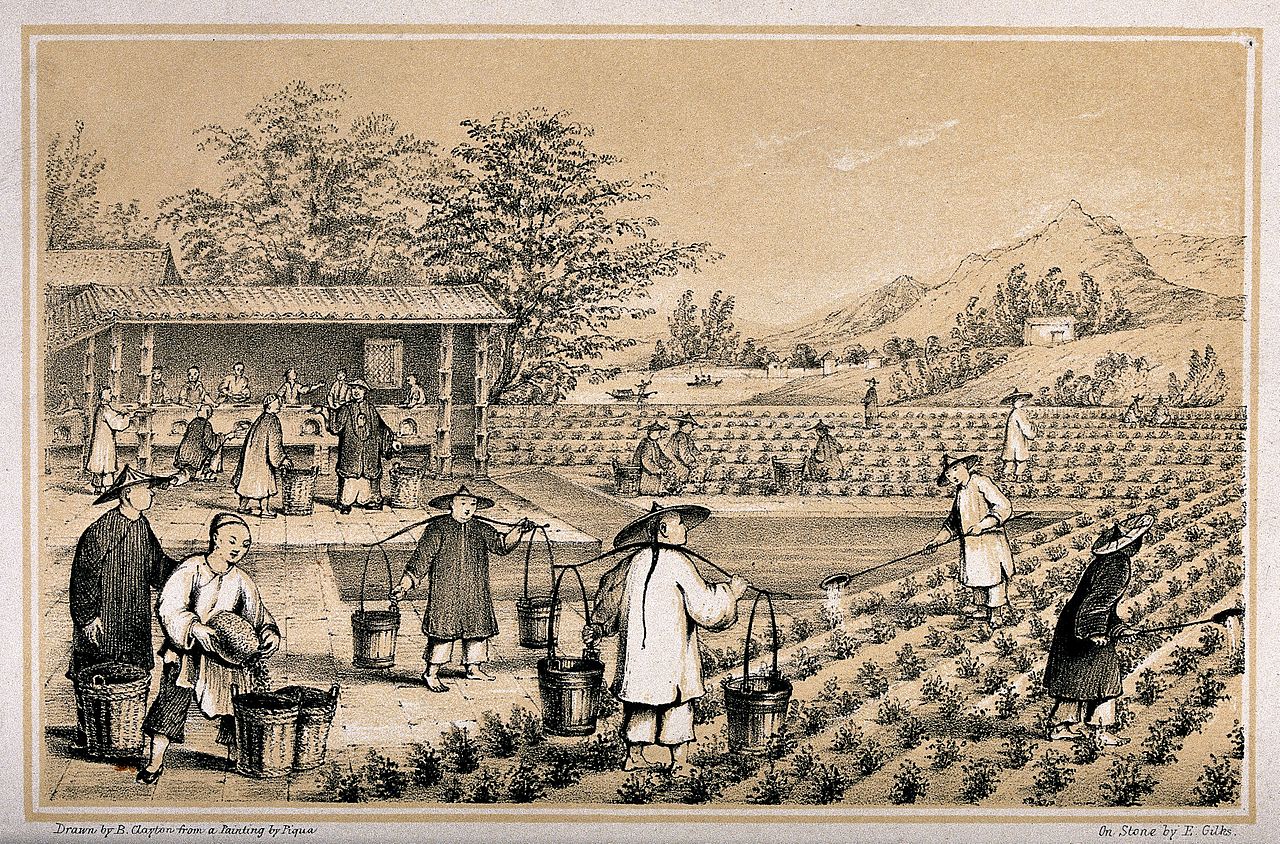
A Chinese tea plantation with workers watering, picking, and firing the tea. Lithograph by E. Gilks, c. 1850, after B. Clayton after Piqua. (Wellcome Images)
Though it has often been said that the conventional understanding of the history of capitalism is Eurocentric, few have attempted to seriously rewrite that history from a non-Eurocentric perspective. In telling the story of the nineteenth- and early-twentieth-century global tea trade, historian Andrew B. Liu rises to this challenge with Tea War: A History of Capitalism in China and India. Examining the intense capitalist competition between the tea production districts of Qing China and colonial India, he shows how that rivalry shaped economic relations, everyday lives, and the ways in which intellectuals in the two societies made sense of national development and political economy.
Beyond its depiction of China and India’s very early absorption into the dynamics of global capitalism, Liu’s account also shows how a sensitivity to the way the Global South historically experienced capitalism pushes us to rethink what capitalism essentially is. This revised understanding of capitalism holds important implications as we struggle to conceive of socialism as a political project on a global scale today.
Global Capitalism as Competitive Accumulation
By the nineteenth century, the global tea trade had become the prototype of a highly integrated market worldwide, featuring not only a gigantic volume of commodity exchange but also fierce competition between different tea-producing regions. Among these regions, the tea countries of Huizhou and the Wuyi Mountains in China, and Assam, India, emerged as the major competitors. Not only were they objectively bound to compete with each other by the structure of the global market, they also explicitly viewed each other as rivals. Assam was converted to tea production in the mid-nineteenth century with the explicit goal of overtaking China’s position in the tea trade. Technicians and laborers were brought in from China to help set up tea production there. Similarly, China’s Qing court sent delegations to study India’s tea production methods in the early twentieth century.