Michael Apted’s Up, a Decades-Long Film on Britain’s Class System
The 1964 film Seven Up! asked 14 British seven-year-olds about their hopes of being the “shop steward and the executive of the year 2000.” Revisiting them every seven years for more than half a century, director Michael Apted made his interviewees into familiar faces — and shone a light on changing notions of class in Britain.
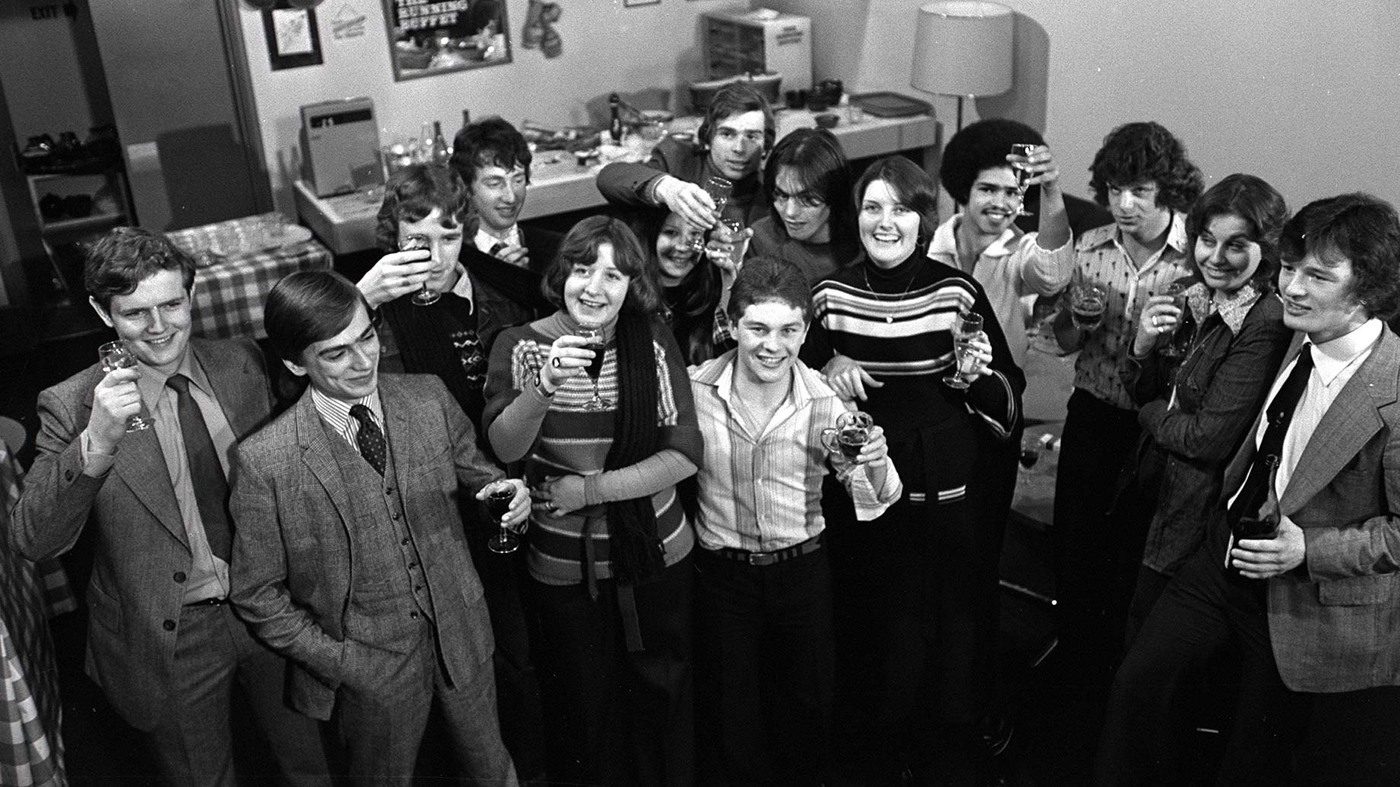
The men and women from the Up series pictured in their twenties. (Granada Television)
The Up series of TV films — the first of which was aired in May 1964, with the most recent coming fifty-five years later in June 2019 — is certainly the longest-running documentary series of all time. Yet it was only by chance that it came to be. The first episode, made up of interviews with fourteen seven-year-old children from across British society about their lives and future prospects, was intended as a single stand-alone episode for the current affairs show World in Action. Broadcast on the recently launched Granada Television, the Manchester-based alternative to Britain’s BBC, the first part was titled Seven Up!, and its aim was didactic, if not polemical. By asking the children a series of fairly leading questions about their understanding of class, society, the lives of those around them, religion, and culture, it was intended as an indictment of Britain’s class-stratified society. In director Michael Apted’s words, it would tell “the truth of the class system out of the mouths of babes.”
Apted’s initial involvement was as a researcher for the Canadian director, Paul Almond. For three frantic weeks, Apted, a recent Cambridge graduate, searched the country for “representative” seven-year-olds, all of whom were to be both confident in front of the camera and somehow a stand-in for an entire social group. The result was a huge television event. Watching it again now, over half a century later, it’s not difficult to see why. Of those fourteen children, we have cheeky-chappy East End lad Tony, racing around the schoolyard, mimicking the accent of the posh boys, playing up in the classroom. There’s bashful Nick, a farmer’s son in the Yorkshire Dales; Neil and Peter, bright-eyed and engaging children from a middle-class Liverpool suburb; Lynn, Jackie, and Sue, three sharp and funny working-class girls from East London; and, perhaps most notoriously, Andrew, John, and Charles, prep-school boys who already at age seven brag about reading the Financial Times for stock tips, and whose future — “I’m going to Charterhouse,” Andrew says, “and after that Trinity Hall, Cambridge” — is already certain.
Up started as a social experiment to portray Britain’s postwar class rigidities — and, in the words of the voice-over, to find “the shop steward and the executive of the year 2000.” Yet it turned into a stunning portrait of not only five decades of social and cultural change, but also the lives of fourteen people who each, in their own way, become intimate companions, opening their lives up to us once every seven years.