The Revolutionary Genius of Ludwig van Beethoven
250 years after his birth, Beethoven’s music still has an exhilarating, subversive power. His revolution of artistic form was intimately linked to his sympathy for the political revolutions of his time.
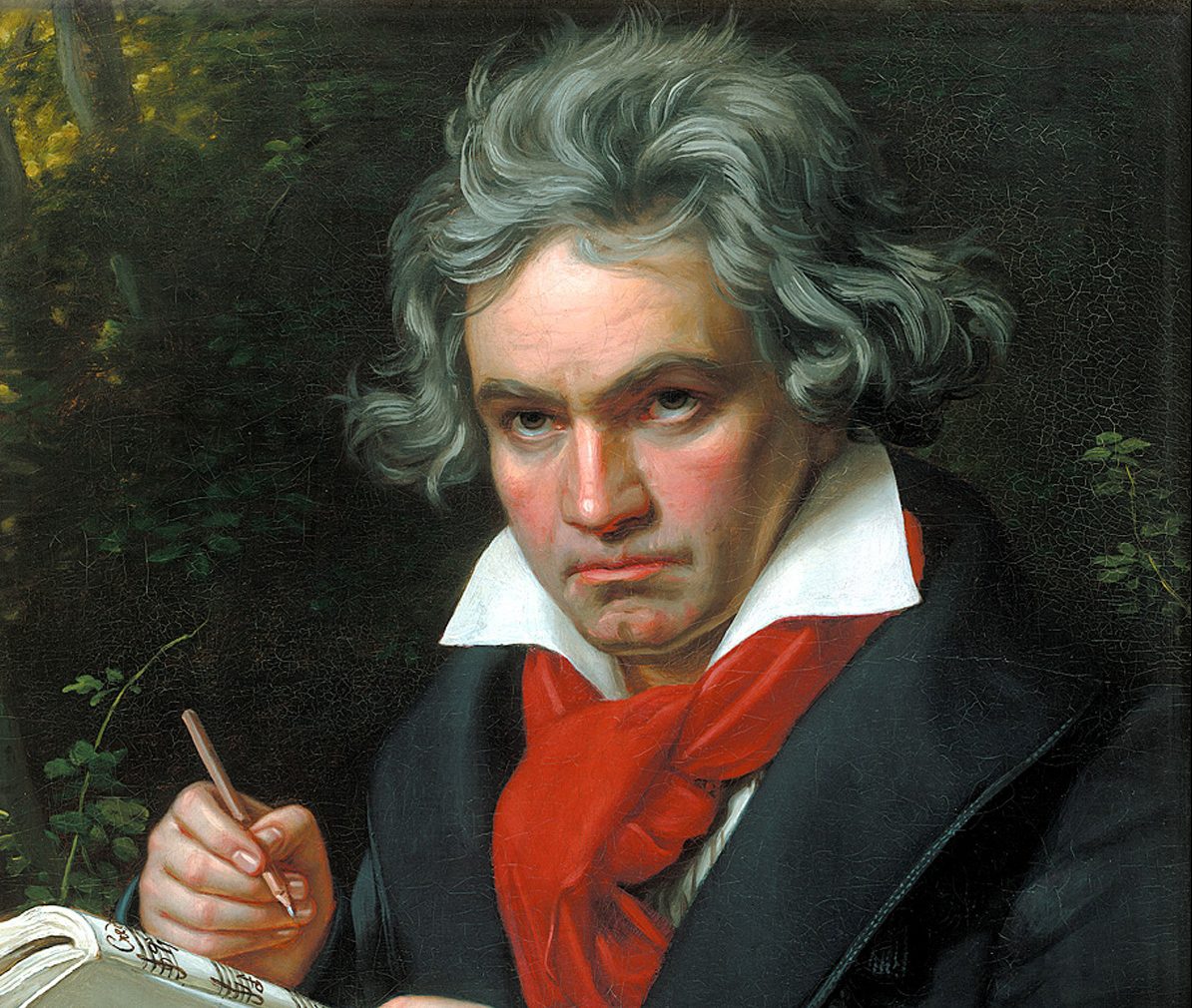
Portrait of Ludwig van Beethoven when composing the Missa Solemnis. (Joseph Karl Stieler / Beethoven House)
Why are we still listening to, and indeed writing about, Ludwig van Beethoven? Two centuries have passed since his music was written and first performed. Even his most esteemed contemporaries, such as Joseph Haydn, Wolfgang Amadeus Mozart, and Franz Schubert, have not been as consistently popular, nor had their music as much analyzed and reinterpreted.
Unlike the music of Gustav Mahler or Anton Bruckner, Beethoven’s has never needed to be rescued from obscurity: it has been a continuous fixture of concert programs since his own lifetime. His music was radical for its time, and even today, there are pieces of his, such as the Grosse Fuge and some of the late string quartets, that remain challenging for the performer and the listener. Yet these pieces have a secure place in the concert repertoire, far outstripping those of modernists like Arnold Schoenberg and Igor Stravinsky.
No other Western classical composer’s music is as much a feature of public events or political propaganda as Beethoven’s. Take one of his most important and famous works, the Ninth Symphony. Performances were organized by trade unions in Germany after World War I, and then during the Third Reich to mark Hitler’s birthday. Rhodesia’s white-supremacist government adopted it as an anthem, and so more recently did the European Union. Leonard Bernstein conducted an orchestra composed of musicians from both East and West Germany as they performed it to mark the fall of the Berlin Wall.