La Pasionaria, Spanish Anti-Fascism’s Greatest Orator, Remained Defiant in Exile
During Spain’s Civil War, Dolores Ibárruri was famed worldwide as La Pasionaria, the brilliant orator who stirred anti-fascists’ souls. Fleeing to Moscow in 1939, she soon became the exiled Communists’ leader — both political guide for a defeated party and a “Spanish mother” confronting the expectations of her male comrades.
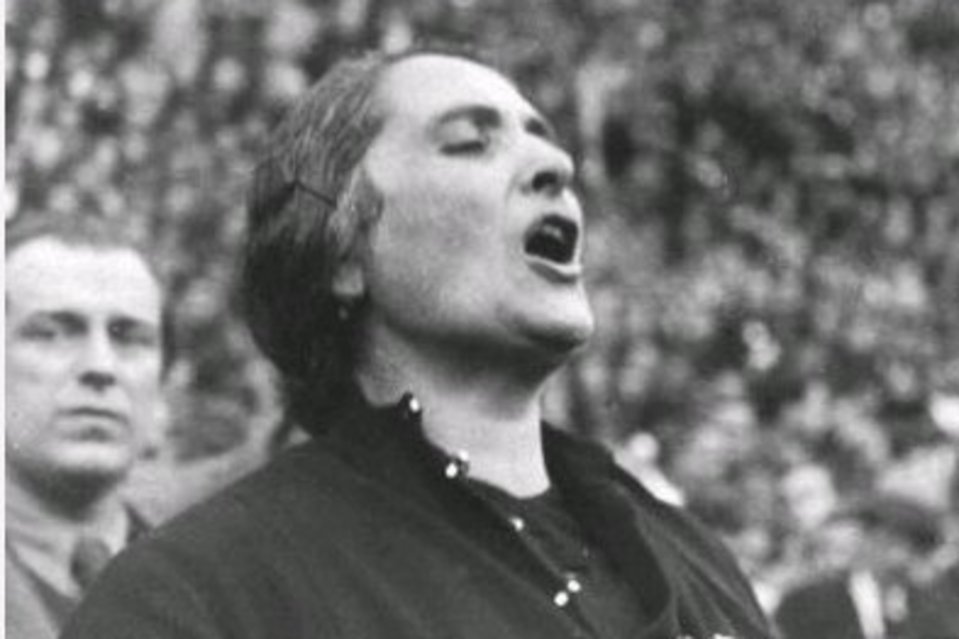
Dolores Ibárruri addressing a rally in Madrid in 1936.
When the Spanish Republic fell in March 1939 after three years of civil war, forcing hundreds of thousands of soldiers and civilians to flee the country, only about two thousand of them were admitted into the Soviet Union. Dolores Ibárruri was the most famous of this select group, and perhaps the most famous woman in the world at the time. Born on December 9, 1895, into a family of impoverished miners in Spain’s Basque country, by 1939, she had become an international symbol of the Spanish struggle against fascism. In one of his earliest columns from Spain, Soviet journalist Mikhail Koltsov described Ibárruri as a “daughter of the people — yesterday a simple, illiterate worker, today one of the leaders of the Spanish Communist Party . . . a simple Spanish woman in a black housedress.”
In her 1962 memoir, Ibárruri presented herself in similar terms. As a young girl, she had dreamed of becoming a teacher. But poverty prevented her from completing her education. In 1916, she married a miner and trade union activist, Julián Ruiz, with whom she had six children; only two survived to adulthood. A year after the Russian Revolution, she began writing for the local miners’ newspaper under the pseudonym “La Pasionaria” — the passionflower. In 1921, she and Ruiz joined the tiny, recently founded Spanish Communist Party (PCE). By 1933, Ibárruri had moved high enough in the party’s ranks to travel to Moscow for a meeting of the Comintern’s executive committee. Her rise to international fame began with the radio address she gave in July 1936, the day after the military launched a coup against the Republic, when she declared “¡No pasarán!” These words would become the most recognizable anti-fascist rallying cry of the era: “They shall not pass!”
During the Civil War, Ibárruri’s popular influence and appeal had less to do with a specifically Communist message than with her powerful — and profoundly gendered — performance of defiance and self-sacrifice. In 1935 or 1936, around the time of her fortieth birthday, she had begun always appearing in widow’s black. This costume disguised the fact that she was separated from her husband and allowed her to turn herself into an icon. In a letter, published in Pravda, to the Soviet actress who had played her in Aleksandr Afinogenov’s 1936 play Salut, Ispanii!, Ibárruri attributed her success as an orator to her ability to express — to become — the suffering and courage of the Spanish people: “My voice is the outraged cry of a people that does not wish to be enslaved . . . In my voice sounds the cry of mothers, the lament of women in bondage, demeaned and scorned.”