Ten Things Biden’s National Labor Relations Board Should Do to Jump-Start Industrial Democracy
Reversing the damage wrought by Donald Trump’s NLRB is not enough. To boost workers’ bargaining power, Joe Biden’s labor board will have to overturn decades of precedents that hamstring organizing and trample on workers’ rights.
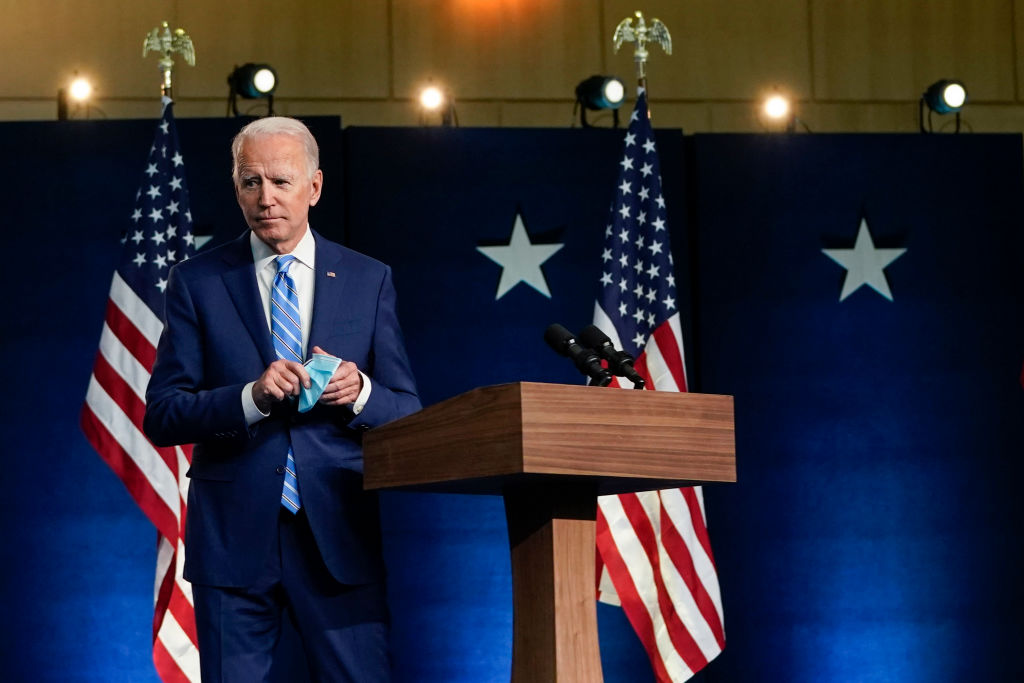
Joe Biden speaking the day after the presidential election on November 4. (Drew Angerer / Getty Images)
Few legal arenas are more volatile than labor law. With the National Labor Relations Act (NLRA) remaining virtually unchanged by Congress since 1959 and the Supreme Court growing increasingly uninterested in interpreting it, the role of creating and changing labor policy governing most private-sector workers in America falls almost entirely upon the National Labor Relations Board (NLRB).
Inevitably, this results in a wild oscillation of reversed precedent whenever the White House flips between a Democrat or Republican. The new appointees to the NLRB typically make it a priority to overturn as much of the past majority’s decisions as possible, paying special attention to those which recently tilted the doctrinal scales in labor’s or management’s favor. This can create chaotic results in some areas of the law. For example, the question of whether graduate students are covered as employees under the act — and thus possess the right to unionize and collectively bargain — has flipped three times since 2000 and is currently slated to change again.
However, many decisions slip through the cracks. This is especially true for rulings that favor management, as union-sympathetic labor boards have essentially been playing a defensive game of whack-a-mole since the passage of the Taft-Hartley Act in 1947. Whether it’s because of a lack of time between elections, legislative sabotage by pro-business politicians, or sheer neglect or acquiescence, many of the most onerous decisions issued by Republican-majority labor boards have been allowed to ossify over the decades as “settled” law, despite often originating as reversals of long-standing precedent dating back to the earliest days of the NLRA.