Workers Will Still Have to Fight Under a President Joe Biden
Joe Biden says he’ll be a pro-labor president. But his funding from anti-union corporate executives, his Obama administration record, and his flirtation with Silicon Valley all point to a gap between rhetoric and reality.
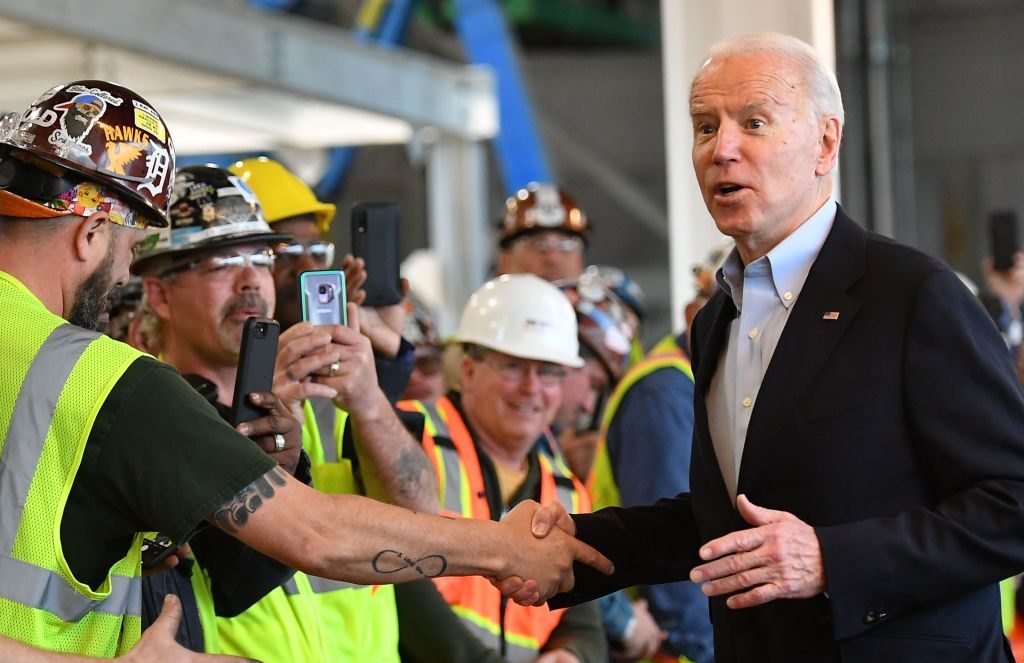
Joe Biden meets workers as he tours the Fiat Chrysler plant in Detroit, Michigan on March 10, 2020. (Mandel Ngan / AFP via Getty Images)
“Joe is a union guy. Pass it on,” tweeted the AFL-CIO on Election Day 2020. The labor federation, and many of the unions that comprise it, went all-in on Joe Biden, getting out the vote for the Democratic Party presidential candidate as well as donating funds toward the election effort. (Some independent unions, such as the United Electrical, Radio and Machine Workers of America, or UE for short, were less enthusiastic about Biden, but nonetheless focused their efforts on removing Trump from office.)
But what does “Joe is a union guy” mean? After all, while Biden often touts his hardscrabble roots in Scranton, Pennsylvania, he has never been a member of a labor union. He voted for the North American Free Trade Act (NAFTA), which the AFL-CIO ardently opposed, and supported the Trans-Pacific Partnership (TPP). Almost immediately upon reaching the White House, he and President Barack Obama burned the unions: after campaigning on passing a “card check” bill, a labor priority that would make it easier for workers to join unions, they abandoned the Employee Free Choice Act (EFCA), which included the reform.
So, what can the labor movement expect from a Biden administration?