Overcrowded Refugee Camps Are Designed to Tell Us That Non-Europeans’ Lives Count for Less
The fire at Greece’s notorious Moria refugee camp left over 12,000 people without shelter, but the new camp built to replace it holds only 3,000. The deliberate overcrowding flies in the face of anti-COVID measures, but it also has a clear political message: asylum seekers’ lives are more dispensable than European citizens’.
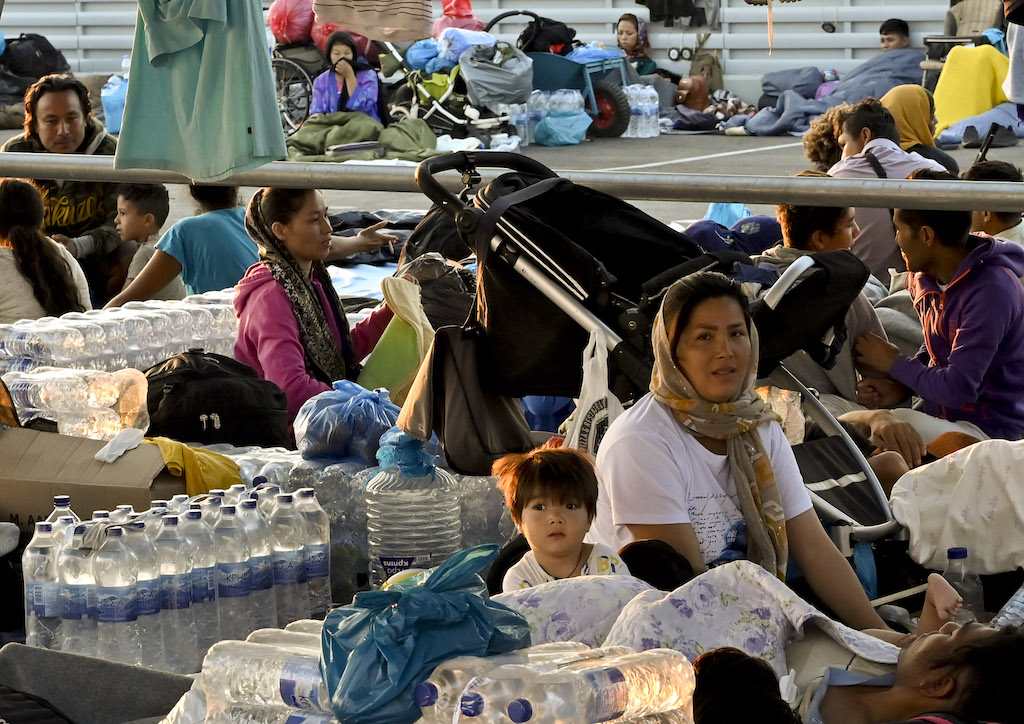
Refugees find shelter outside a Lidl supermarket after a fire destroyed Moria refugee camp on the island of Lesbos on September 11. (Milos Bicanski / Getty Images)
On September 9, flames engulfed the notoriously overcrowded Moria refugee camp on the Greek island of Lesbos, leaving over twelve thousand people without shelter. In the time since the fire, a new camp has been built — but with an official capacity of only three thousand. Many describe the new and massively overcrowded camp as “even worse than Moria,” lacking essential facilities like baths and clean toilets.
The former Moria residents and activists, as well as locals living in Lesbos, oppose the building of a new camp — instead call for the relocation of the asylum seekers to countries around the European Union. Yet even given these dire conditions, EU countries are only making symbolic gestures; Germany and France each pledged to take 100 to 150 children, the Netherlands fifty children and Finland as few as eleven. Meanwhile, at least 240 asylum seekers have tested positive for the new coronavirus.
Professor Nikos Xypolytas is part of the sociology department at the University of the Aegean, focusing on migration and labor. Having interviewed many of Moria’s former residents, he sees the burning of the camp as a “symbolic event” in the continent’s so-called “migration crisis.” With winter looming over the poorly housed asylum seekers, Jacobin’s Elena Gagovska spoke to Xypolytas about the destruction of Moria and the future of European Union migration policy.