How Greece Became Europe’s “Shield” Against Refugees
Five years after Alexis Tsipras proclaimed his government’s solidarity with migrants, he has joined European Union leaders in calling for Greece to “close the borders.” The narrative of migrant “invasion” has mainstreamed far-right ideas — turning nationalist rhetoric into violent attacks on refugees.
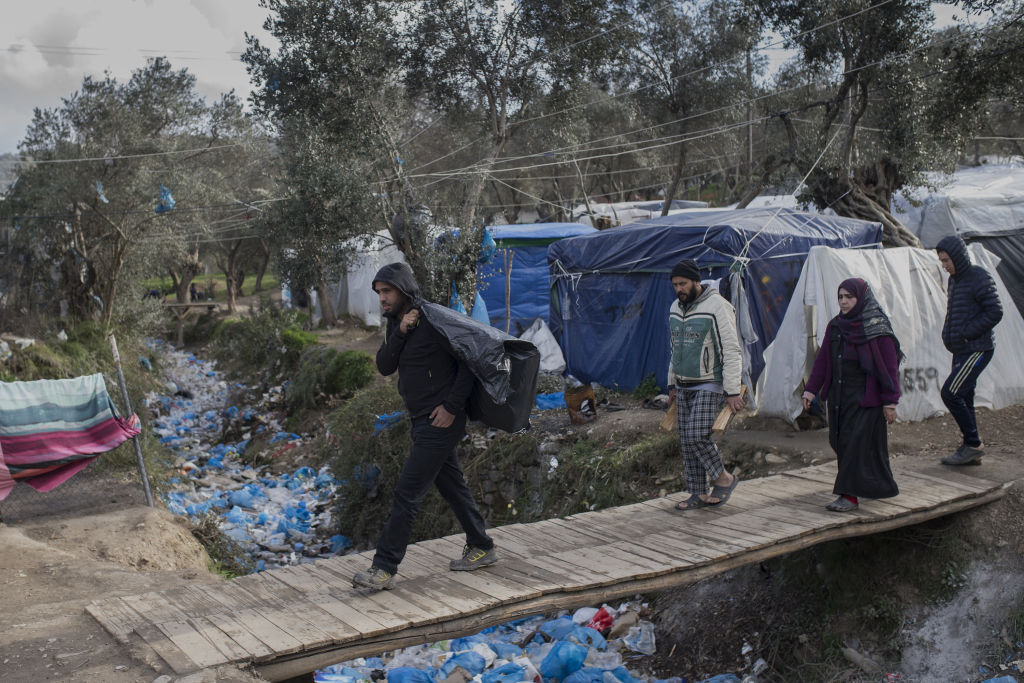
Asylum seekers are seen in the Moria Camp as they continue to wait to reach Europe in Lesbos Island, Greece, on March 09, 2020. Ayhan Mehmet / Anadolu Agency via Getty
Greece is again at the epicenter of a refugee crisis. But if back in 2015 and 2016 the Mediterranean country took a leading role in providing refuge for the victims of war, the situation today is quite the opposite. Now we’re seeing an outbreak of violent xenophobia against the refugees who’ve been stranded on Greek territory over the last four years — and, indeed, those attempting to cross the border from Turkey. Given the country’s recent record of solidarity with migrants, this severe cultural intolerance may seem surprising. Yet this is just the symptom of a deeper transformation of Greek society — one in which xenophobia risks becoming the organizing principle of national politics.
The last week saw a number of worrying developments in this regard. This particularly owes to protests on the islands of Lesbos and Chios, where the bulk of refugees have “provisionally” been settled for the past four years. With capacity on the islands exceeded four times over, the New Democracy government elected in July 2019 has sought to decongest the islands, moving the refugee population to camps in continental Greece. Yet local authorities on the mainland have fiercely resisted this with demonstrations and occasional roadblocks. Fearing a loss of its electoral base, the government decided to cut its losses and site new detention centers on Lesbos and Chios instead of in continental Greece.
The crisis accelerated on February 25, as riot police dispatched from Athens to guard the sites of these future detention camps were attacked by islanders. The following day, an angry mob burst into a hotel used by riot police, beating up officers and throwing out their belongings. This show of resistance gained the protesters many sympathizers among the Greek public, especially after there were reports of frustrated police insulting the locals and footage emerged of officers ruining local property. Yet this wasn’t just a local community’s resistance against state authority: their protest was directed not against the detention of refugees but against the presence of refugees as such. They read the government plans as further consolidation of the refugees’ presence on their land — and they were determined not to let it happen.