The Climate Movement Must Disrupt the Normal Routines of Fossil Capital
Despite all the mounting evidence of climate catastrophe, fossil fuel companies are still planning to carry on business as usual. The climate movement must be ready to use tactics that disrupt the normal routines of fossil capital and prompt states to take meaningful action.
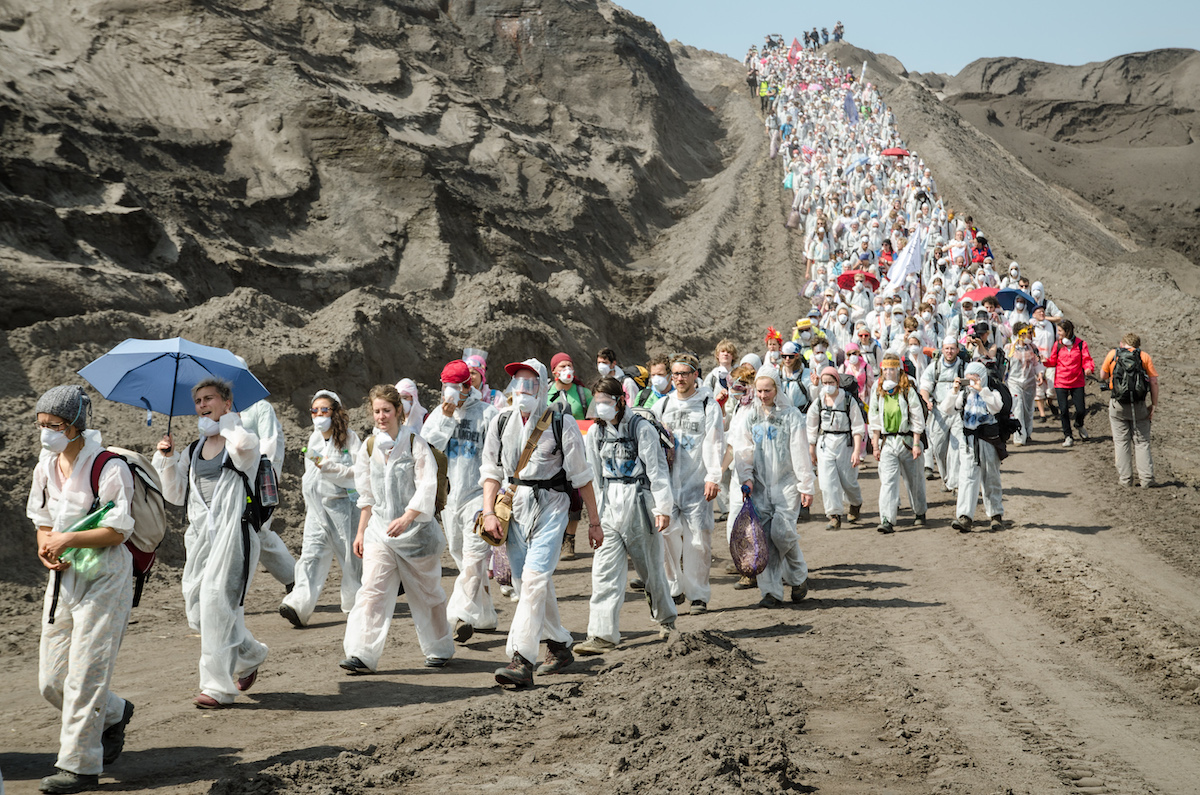
A photo from the Ende Gelände climate camp in Germany in 2016. Photo: Ende Gelände
All three cycles of climate protest in the twenty-first century have spun out of an insight, more and more widely shared: the ruling classes really will not be talked into action. They are not amenable to persuasion; the louder the sirens wail, the more material they rush to the fire, and so a change in direction will have to be forced upon them. The movement must learn to disrupt business as usual.
To this end, it has developed an impressive repertoire: blockades, occupations, sit-ins, divestment, school strikes, the shutdown of city centers, the signal tactic of the climate camp. Later cycles have built on and learned from prior ones. Toward the end of the second, much inspired by the North American struggles against pipelines, the German movement reinvented the climate camp formula and brought it to a higher level of mass defiance: Ende Gelände, meaning roughly “here and no further,” was born.
Upward Curve
At Ende Gelände, activists pitch their tents around a central area of circus tents and kitchens. They undergo training in affinity groups, dress up in thin white coveralls, and set out for a brown coal mine. Approaching the target from several directions, in brigade-like columns or “fingers,” they excel in breaking through police cordons with the sheer mass of their bodies, running past outwitted guards, making their way through water cannons and fences until they reach the open pits.