Mass Uprisings and Their Aftermath in the United States and Chile
Both Chile and the United States have seen massive social upheavals over the past year. The two countries have much to teach each other about how such unrest can translate into substantive political change.
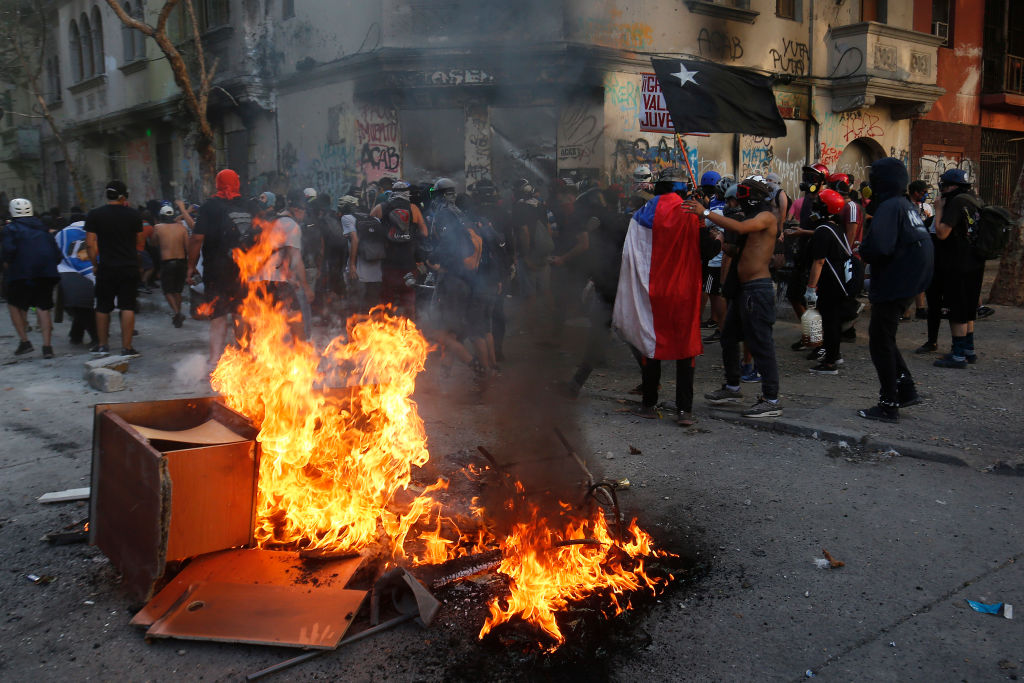
Demonstrators set a fire during a protest against President Sebastián Piñera on February 21, 2020 in Santiago, Chile. An increase in the subway fare in October 2019 triggered protests and social unrest against inequality. (Marcelo Hernandez / Getty Images)
In October 2019, Chile faced a sudden and massive upheaval following a metro fare hike of 30 pesos (about four cents). This was a relatively small fare increase, but one that immediately became the straw that broke the camel’s back. The uprising brought together, at its peak, more than one million people on the streets in one day and continued for months with thousands of protesters, yielding both a few victories and much remaining uncertainty — a situation not unlike the one the United States finds itself in after unprecedented protests over the police murder of George Floyd.
Recently, we organized an exchange between Democratic Socialists of America (DSA) and elected leaders of Revolución Democrática (RD), a Chilean political party. RD was born in 2012 after the student strikes calling for free and public education. RD is also the largest member of a political coalition of four parties called Frente Amplio (“Broad Front”). The alliance’s presidential nominee Beatriz Sánchez received 20 percent of the votes in the first round, barely missing the opportunity to be one of the final two candidates. The conversation between DSA and RD drew clear parallels between the Chilean uprising and the ongoing uprising in the United States.
During the Chilean protests, a common refrain was: “No son 30 pesos, son 30 años” (“30 years, not 30 pesos”). The principle was that while the transit price increase may have triggered the uprising, it was not the real cause of the mass protests. Instead, the deeper cause was the accumulation of injustices and indignities throughout Chile, the ridiculously high cost of living in the country, the obvious social and economic inequality that characterize Chilean life, and a wide range of unfair policies enforced and protected by a constitution that was not deeply changed after the end of the Pinochet dictatorship in 1989.