German Unions Are Waking up to the Climate Disaster
The call to stop the production of coal and cars often sounds like a threat to jobs. But German trade unions have realized that the green transition needs to happen — and they’re fighting to make sure it’s bosses, not workers, who pay for climate justice.
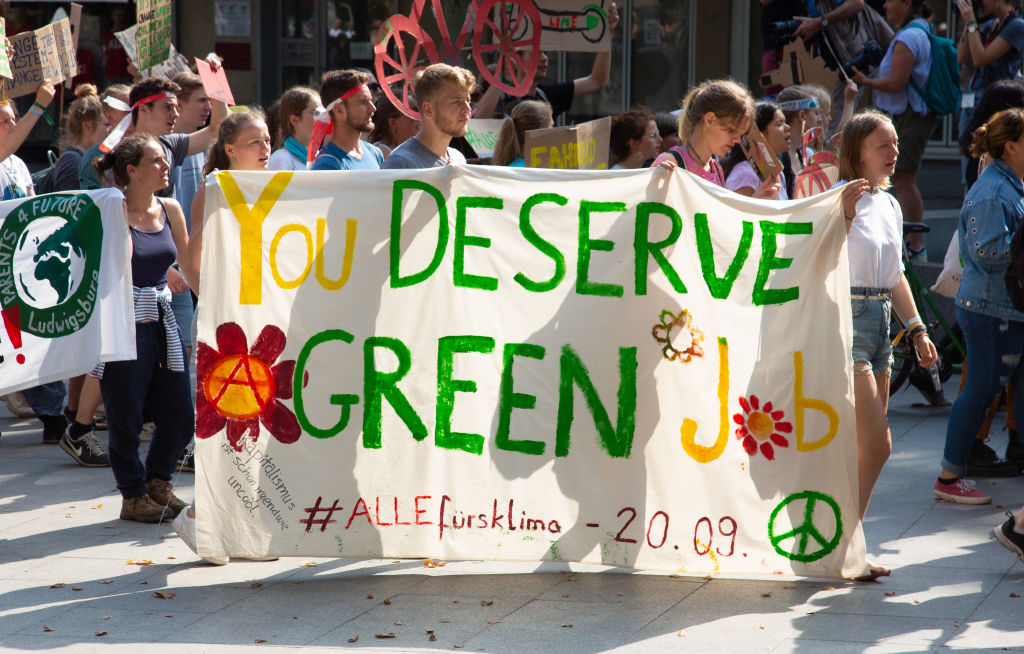
Supporters of the Fridays for Future climate change movement participate in a demonstration during a five-day Fridays for Future congress on August 2, 2019 in Dortmund, Germany. (Juergen Schwarz / Getty Images)
If the summer holidays interrupted the school walkouts, the teenager-led Fridays for Future movement hasn’t let up its fight to save the planet. Ever since the start of the movement, leaders like Sweden’s Greta Thunberg and Germany’s Luisa Neubauer have worked to build broader social ties than previous generations of environmental activists, including with organized labor. In this spirit, September 20 will see the beginning of the “Earth Strike,” a planned week-long general strike around the world to stop production and draw political attention to the climate emergency.
The need to “save jobs” has historically been counterposed to the call to shut down harmful industries. Yet the sheer scale of the catastrophe we face has focused minds on the need to overcome the divide between green and labor activism. In particular, the mainstreaming of the demand for “climate justice” — arguing that the poor, vulnerable, and exploited shouldn’t be the ones paying for the transition to a green carbon-neutral economy — has shown that saving the planet and social justice really can go hand in hand. This is epitomized by Alexandria Ocasio-Cortez’s call for a Green New Deal.
Germany has an especially deep-seated history of ecological mobilization, with even radical campaigns enjoying wide popular support. Its environmental movement has historically been characterized by a strong anti-authoritarian current — indeed, in the 1970s and 1980s, the movement to halt nuclear-waste transports used forms of civil disobedience associated with the US civil rights struggle.