Anti-Corruption Protests Show the Hollowness of Bulgaria’s Democracy
More than three months since they began, the daily anti-corruption protests against Boyko Borissov’s administration are still headline news in Bulgaria. But the rival corruption allegations leveled by both the Left and Right also highlight the lack of real political alternatives — with the country’s harsh social inequality and rising poverty levels drawing no similar political attention.
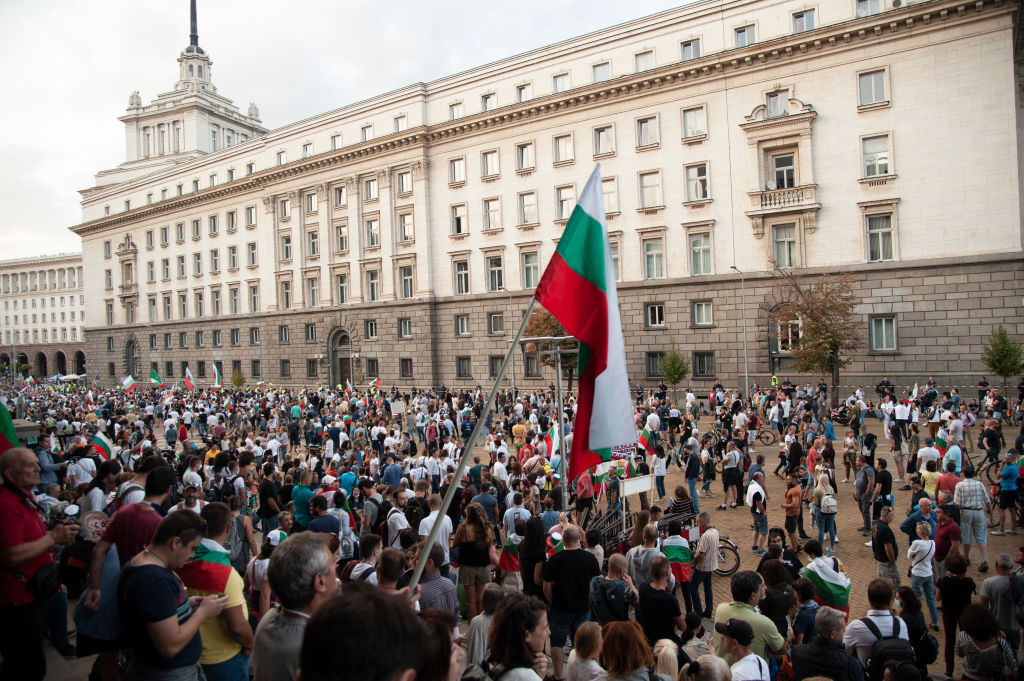
People gathered at antigovernment protest near the National Assembly building on September 22, 2020 in Sofia, Bulgaria. (Hristo Rusev / Getty Images)
Protests demanding the resignation of Bulgaria’s prime minister Boyko Borissov and attorney general Ivan Geshev have now continued for over a hundred days, with daily rallies continuing across the country. The target of protesters’ ire is the ruling coalition led by Borissov’s Citizens for European Development of Bulgaria (GERB) party, now widely discredited following a series of corruption and tax evasion scandals, controversial Black Sea construction projects, and a deep social crisis. A European Parliament survey showed that the income of half of Bulgarian citizens was impacted by the pandemic. Yet protest organizers have refrained from criticizing concrete policies or the administration’s response to the COVID-19 crisis — instead seeking to paint the government as entirely illegitimate.
In this context, it is not surprising that over 65 percent of the population say they support the protest. Less clear, however, is what exactly the Bulgarian people want. Opposition forces on both the Left and Right demand snap parliamentary elections. However, these same forces align with the government and Geshev in promising “equality before the law,” while at the same time utterly disregarding the rampant social inequality in the country. While most Bulgarians face low wages, high unemployment, and an ailing health care system, such concerns go practically unaddressed by either side in parliament.
This restriction of the political discourse in Bulgarian politics has gone on for over twenty years. The country’s political parties, the postcommunist Bulgarian Socialist Party included, generally avoid speaking about using the welfare state to address inequality and poverty, for fear of being associated with the old socialist regime. What it means for the country, however, is that there is no credible actor on the political stage to take up protesters’ social grievances in a meaningful way, let alone offer real solutions.