The Portuguese Revolution and Women’s Liberation
After the overthrow of Portugal’s fascist regime in 1974, a radical movement arose to challenge the near-total lack of rights accorded to women. The violent breakup of the movement’s first protest showed how difficult their struggle would be — yet their activism helped bring about a lasting transformation.
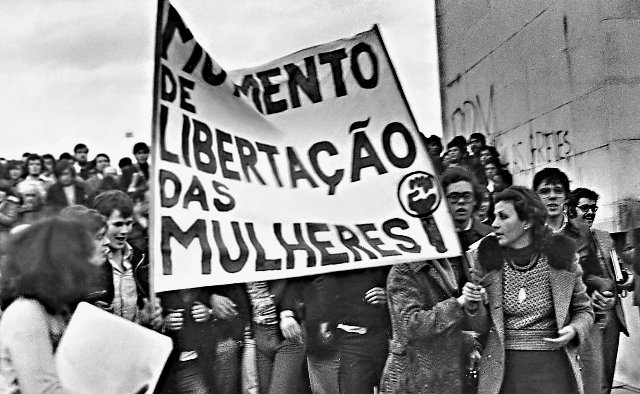
The feminist group Movimento da Libertação da Mulher (MLM), Portugal’s Women’s Liberation Movement.
When Isabel Telinhos left her apartment all dolled up on January 13, 1975 — high heels, tight skirt, fake eyelashes, and a curly blond wig like Marilyn Monroe — she had no idea what would happen next.
“I brought my kid with me and everything, like all these other women. It was supposed to be a small protest, just a few journalists, so we could talk about the issues and get some coverage in magazines.” The protest followed several actions by the feminist group Movimento da Libertação da Mulher (MLM), Portugal’s Women’s Liberation Movement. “We felt like we needed a radical wake-up call. If it’s not radical, nothing changes. In any political situation, actions must be radical.”
It’s been over forty-five years since that fateful Monday afternoon in 1975. MLM had organized a performance in Parque Eduardo VII, Lisbon’s largest central park. But when the fifteen or so women got there, they were welcomed by a crowd of men: “A crowd that quickly turned into a horde,” remembers the renowned Portuguese journalist Adelino Gomes. “It wasn’t just a group of people catcalling these women. It was a horde,” stresses Adelino. “At one point, when they started walking, these men started chasing after them, and the whole thing got out of control.”