How the Medieval Jacobins of Bohemia Fought Against — and Terrified — Europe’s Aristocracy
On this day in 1420, a force of peasants and artisans won a famous victory at Vitkov Hill on the outskirts of Prague — the high point of Bohemia’s Hussite revolution. The Taborite rebels dreamed of social equality and terrified Europe’s rulers, but they were too far ahead of their time.
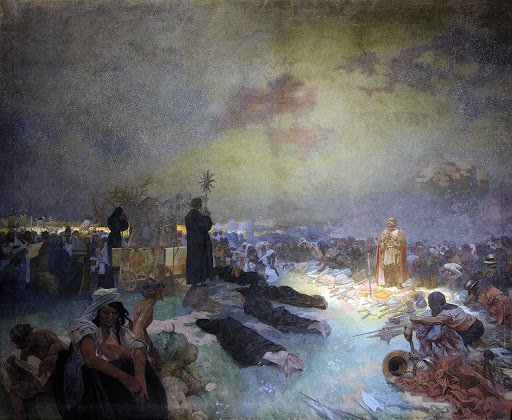
After the Battle of Vítkov Hill, Alphonse Mucha, 1923.
With the exception of England, perhaps, no country exhibited so rapid an economic development during the fourteenth century as Bohemia. In England, this was specially favored by the wool trade, and by successful predatory incursions into France; in Bohemia by its silver mines, in which that of Kuttenberg ranked foremast.
The rapid development of Bohemia’s power at that time depended chiefly on those mines. Thanks to Kuttenberg’s capacity of production, trade and industry, as well as the arts and sciences, flourished in Bohemia, above all in Prague, which was covered with splendid buildings and the seat of the first University of the German Empire. Nor did the Church go empty-handed.
Æneas Sylvius, later Pope Pius II, who was well informed concerning the possessions of the Church, writes in his History of the Bohemians: “I believe that in our age there was in all Europe no country in which so many and such magnificent and richly adorned places of worship were to be found as in Bohemia.” But the exceptional opulence of the Church in Bohemia only served to increase its spoliation by the Pope.