Teachers’ Unions Are Demanding Police-Free Schools
A major lesson from the recent teachers’ strike wave was the necessity for unions to bargain for the common good of the entire working class. By joining the nationwide protests against police brutality and demanding police-free schools, teachers’ unions have taken that lesson to heart.
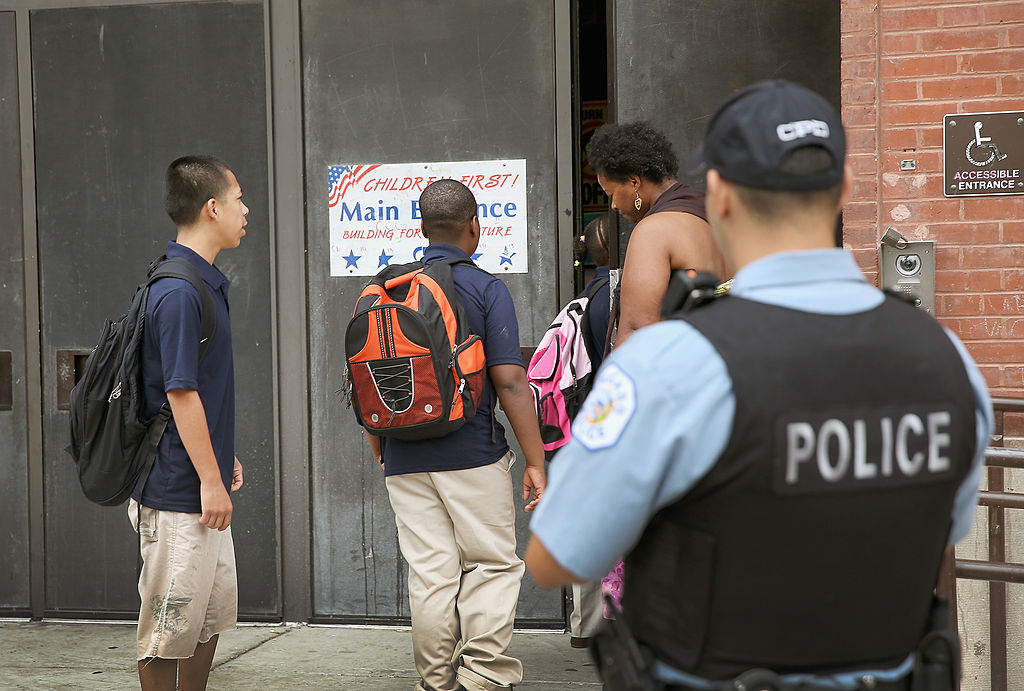
A Chicago police officer watches as students arrive at Laura Ward Elementary School on the Westside on August 28, 2013 in Chicago, Illinois. Scott Olson / Getty Images
It’s been three weeks since Minneapolis police officer Derek Chauvin killed George Floyd by kneeling on his neck for nearly nine minutes. Protests continue in cities, suburbs, and even small towns all over the United States.
The sheer volume of political activity makes it hard to focus on any particular development. But there’s something important happening right under our noses that has received far too little attention outside of disconnected local media stories. Across the country, teachers’ unions are joining the movement for police-free schools.
Teachers unions signing on to the police-free schools movement is not only a critical political development that could begin to break down the school-to-prison pipeline, it is also a maturation of the social-movement unionism that animated the teachers’ strike wave. For decades, many unionists have argued that it’s critical to connect the bread-and-butter demands of union members to issues affecting other members of the working class, as well as progressive organizing already happening outside of their unions. The Red for Ed teachers’ strike wave was the best sign yet that this orientation towards social-movement unionism was gaining renewed popularity in the labor movement.