When State Intervention Saves “the Economy,” but Not You
China’s response to the pandemic has sharply contrasted with Trump’s, with a far stronger public health response in China but little aid for the poorest. Both countries’ responses to the crisis show that a strong state doesn’t stand in contradiction with neoliberalism — rather, it’s a key element of it.
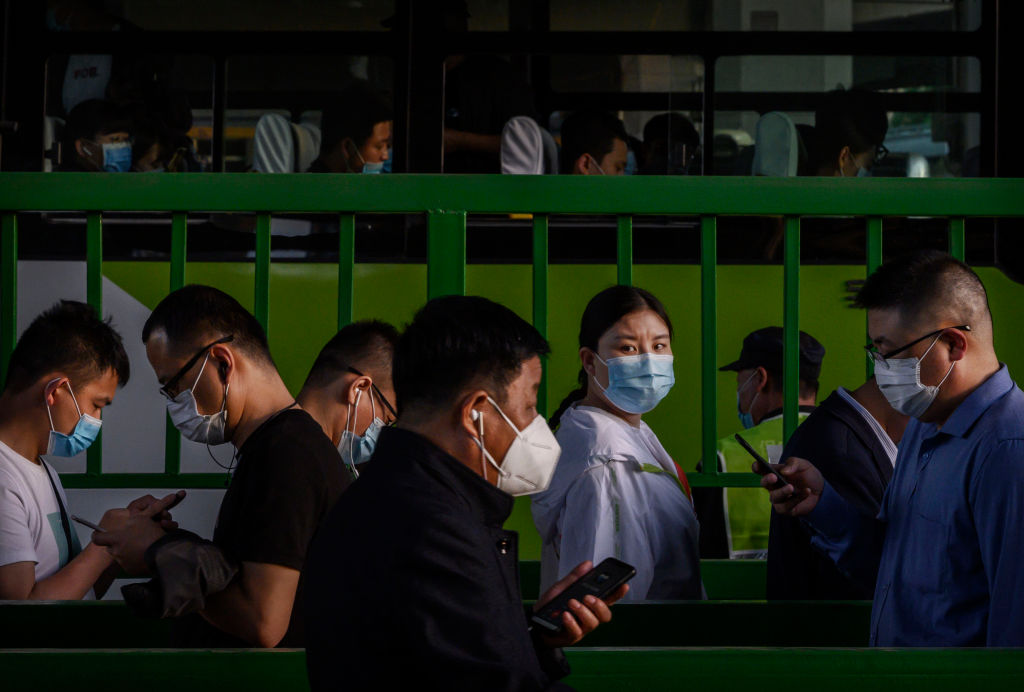
Chinese commuters wear protective masks as they line up to catch a bus at the end of the workday during rush hour on May 18, 2020 in Beijing, China. Kevin Frayer / Getty
Common sense dictates that the global coronavirus crisis ought to be tackled by international collaboration. But in practice, the pandemic will be confronted by each nation-state independently, with no uniform economic response or common speed of recovery. While capitalism is dominated by neoliberal ideology, the decisions made by each government are heavily influenced by the particular power structures, political circumstances, and balance of class forces in each country — divergences likely to become even more pronounced after this crisis.
The most crucial differences are naturally those between the United States — still the hegemonic power — and China, the rising challenger for hegemony. The contrast between their governments’ responses casts light on the balance of power between central and local authorities and between the state and the market in both countries.
The unprecedented expansion of public spending in the United States has, indeed, spurred discussions about whether this crisis signals the “end of neoliberalism.” But contrasting the Chinese and US responses allows us to highlight the need to go beyond the false dichotomy between a strong interventionist state and neoliberalism. Rather, we should focus on how different power structures manifest concretely in the way each country has tackled the crisis so far. This contrast becomes even more relevant given the heightened political tensions between China and the United States, as Donald Trump and Joe Biden campaign over who can “deal” with the Chinese government better.