Why the Neoliberals Won’t Let This Crisis Go to Waste
Many observers expected that the 2008 financial crisis would mark the end of neoliberalism. Instead, we saw a wave of privatization and sharp cuts in public services. Today, the forces best placed to exploit the coronavirus pandemic are still those who already have power: the neoliberals who’ve been shaping the economic policy agenda for decades.
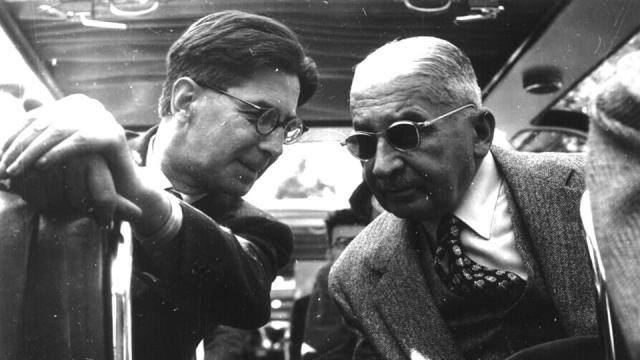
Carlo Antoni and Ludwig von Mises at a Mont Pelerin Society meeting in the early 1950s.
In November 2008, just weeks after the Lehman Brothers collapse, Barack Obama’s chief of staff Rahm Emanuel insisted that the banking crisis wasn’t just bad news for the neoliberals. As the former Freddie Mac board member put it, the dramatic tumult was also the chance to clear away some deadwood — and even push the neoliberal project along further. In his immortal words, “You never want a serious crisis to go to waste. And what I mean by that is an opportunity to do things that you think you could not do before.”
The quote inspired the title of Philip Mirowski’s 2013 book Never Let a Serious Crisis Go to Waste: How Neoliberalism Survived the Financial Meltdown. It provided a rebuke to those who assumed the crisis would simply weaken the dominant economic policy assumptions of recent decades — or that the neoliberals wouldn’t themselves react. Far from the state bailouts of the banks showing that neoliberalism was over, in fact, they were followed by a further wave of marketization of public services — and years of austerity.
Today, faced with the coronavirus pandemic, many observers have again pointed to an opportunity for the Left to change the economic agenda. Such claims may seem to be bolstered by the massive state intervention as well as a widespread political emphasis on the importance of public services. Yet the focus in most Western countries on propping up businesses — and indeed the rowdy protests to end the shutdown — also show how privatizing and reactionary forces can set the tone politically.