Australia’s Youngest Union Is Organizing Retail and Fast-Food Workers
In 2016, the Retail and Fast-Food Workers’ Union was formed in Australia. Representing some of the most undervalued, low-paid workers in the country, RAFFWU is already among the most radical unions, challenging both employers and the conservative fiefdom of the “Shoppies.”
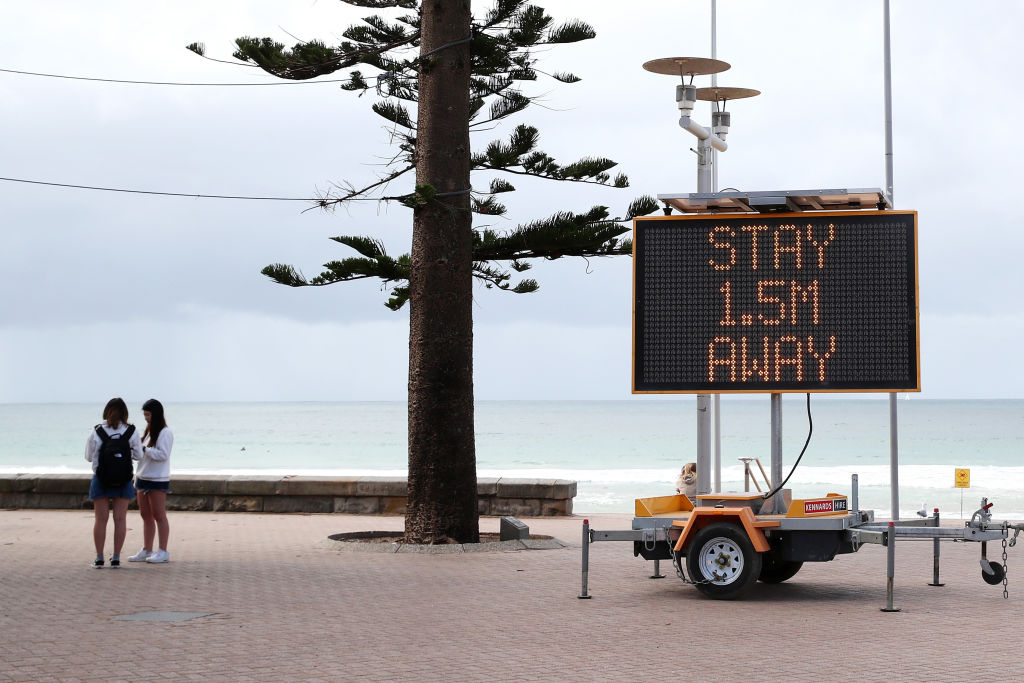
A sign reminding residents and tourists of new social distancing rules is displayed at Manly Beach on March 23, 2020 in Sydney, Australia. Cameron Spencer / Getty
While most Australians went into lockdown, retail workers, hitherto largely undervalued or invisible, have been working at the front line, risking their health to stack, pack, scan, and deliver our groceries, household supplies, and electrical goods. For some, the crisis sparked a sudden realization that workers who supply us with food, furniture, and electronics are “essential” for society’s functioning. Some media outlets have even dubbed them “heroes.”
This recognition has not resulted in material recompense. Instead, as the virus caught hold, so did panic buying. Major supermarkets — notably Coles and Woolworths — were slow to address workplace safety concerns and resume delivery services. Electronics retailer JB Hi-Fi refused worker demands to close stores and move temporarily to a delivery-only business model. McDonald’s has cried poor, citing the crisis to justify attacks on conditions, while Best Buy, which has 279 stores in Australia, has sacked casual workers worldwide, despite surging online sales. Kmart at Chadstone only closed its doors after two of its employees tested positive. At Brandon Park, even this wasn’t enough to force Kmart to stop trading. These employers appeared to be primarily concerned with capitalizing on panic buying, at the expense of worker and community safety. Making matters worse, some stockpiling shoppers verbally and physically assaulted workers and brawled with one another. A small few deliberately broke social distancing and even spit on money and credit cards.
Insecure, underpaid, and often dangerous work is not just a feature of the global health crisis — it’s built into Australian capitalism. Illegal underpayment of workers is a business model for many employers.