Trump’s “Maximum Pressure” on Iran Is Making COVID-19 Worse
Even as Iran’s coronavirus death toll nears 5,000, US sanctions continue to bear down on the country’s health care system.
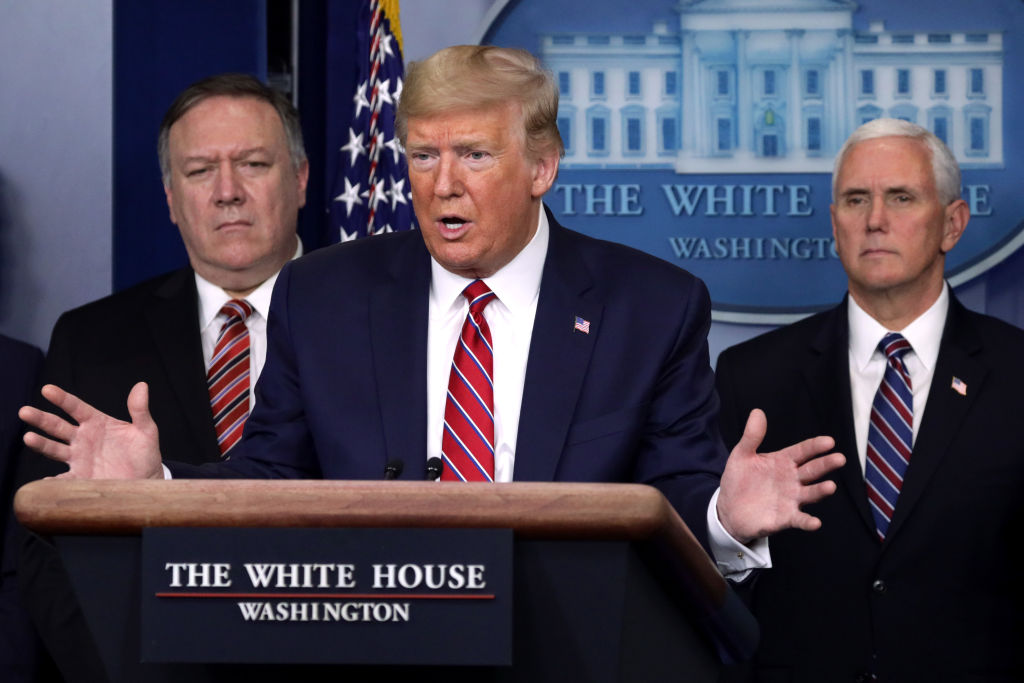
US president Donald Trump speaks as secretary of state Mike Pompeo and vice president Mike Pence listen during a news briefing on the latest development of the coronavirus outbreak at the White House March 20, 2020 in Washington, DC. Alex Wong / Getty
The impact of the sanction regime continues to hold center stage as Iran battles twin humanitarian and economic catastrophes. Indeed, the situation on the ground is continuing to worsen. As of April 17, Iran reported an official death toll of nearly 5,000, and a total number of 77,995 cases. Significant material relief is unlikely in the coming days. The International Monetary Fund (IMF) is facing US obstruction over Iran’s request of a $5 billion loan to finance the purchase of medical equipment, and it is scrambling to circumvent the impasse through alternative channels. In spite of this, Iranian president Hassan Rouhani has announced an ease of lockdown measures from April 18, which will allow “low-risk business to reopen.” This move is controversial — with experts warning of the potential for a new increase in cases.
In the midst of this crisis, twenty-four senior diplomats have publicly urged the United States to ease sanctions. They are calling for the United States to refrain from using its veto power to block Iran’s loan request to the IMF, as part of a transnational and bipartisan effort captained by former EU foreign minister Federica Mogherini. This appeal is falling on deaf ears, however, given the wider geopolitical pressures surrounding the crisis.
Despite the public health emergency, both Iran and the United States are escalating rhetorical attacks and maintaining a confrontational posture in the Persian Gulf. The latest incident has seen a temporary seizure of a tanker on Iran’s part on April 14, and hazardous maneuvers by Revolutionary Guard Corps (IRGC) ships near a US warship on April 15. These episodes have the potential to escalate tensions in a manner reminiscent of last summer’s tanker diplomacy, at a moment when international cooperation is needed the most.