Lean In to Your Quarantine Anxiety and Read Super Sad True Love Story
Gary Shteyngart’s novel Super Sad True Love Story was published a decade ago, and it offers a portrait of a near-future, dystopian United States that might suddenly be upon us. It’s perfect reading for the pandemic lockdown.
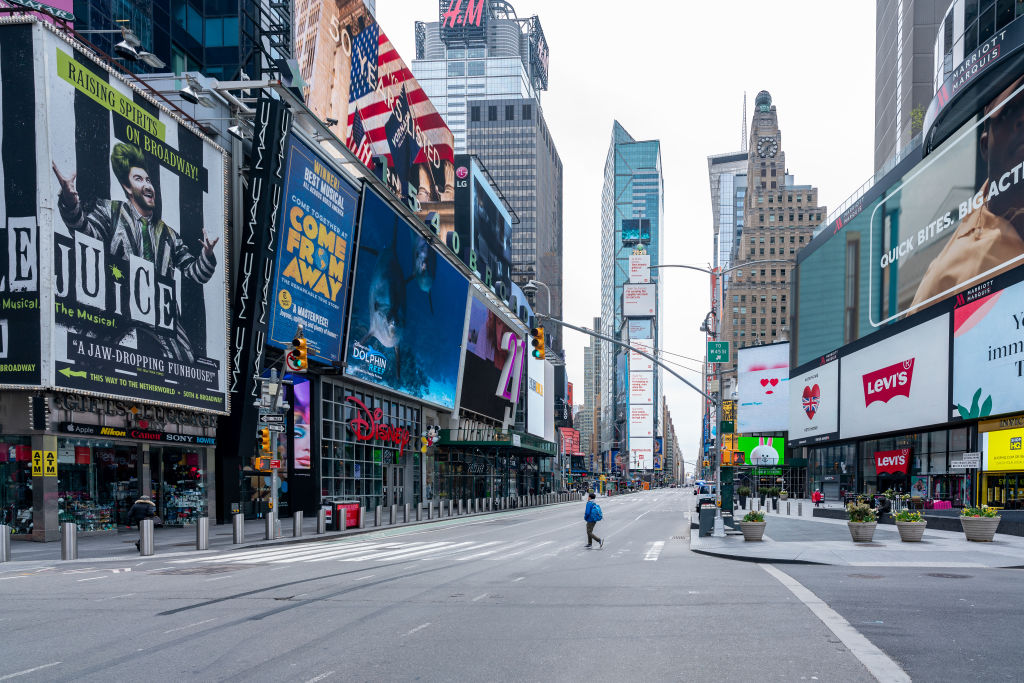
A person crosses the street at very quiet Times Square on April 20, 2020, in New York City. David Dee Delgado / Getty
In media commentary on the extraordinary crisis response of governments, health care systems, and central banks to the COVID-19 pandemic, wartime analogies abound. Yet, as some commentators have pointed out, far from the mass mobilization of productive capacity and labor that characterized total war, the bulk of today’s workforce in Europe and North America is temporarily siloed, and production increasingly limited to those sectors necessary to keep the lights on at home, food on the shelves, and hospitals adequately provisioned.
Whilst healthcare professionals and other “key workers” are overworked and under strain as never before, for many of us, the standard wartime analogy doesn’t really hold — getting up and checking on yesterday’s death toll over the first cup of coffee may have a wartime analogue, but it’s closer to Robert McNamara’s daily routine during the Vietnam War than it is to the experience of combatants in the field.
To assist in filling the unexpected downtime, news sites have been chock-full of articles on suggested reading — from old favorites to pandemic-related dystopian fiction. For those who eschew comfort reading and prefer to lean in to their anxiety, Gary Shteyngart’s 2010 work of speculative fiction, Super Sad True Love Story, makes for excellent — if disquieting — lockdown reading.