We Should Have a Democratic Debate About Trade-Offs Between Public Safety and Privacy
Locked down, smartphones are giving many of us some comfort and connection now. But the hardware and software that make our phones so indispensable are also tracking us twenty-four hours a day. This crisis will only open the door to more privacy intrusions in the name of public health.
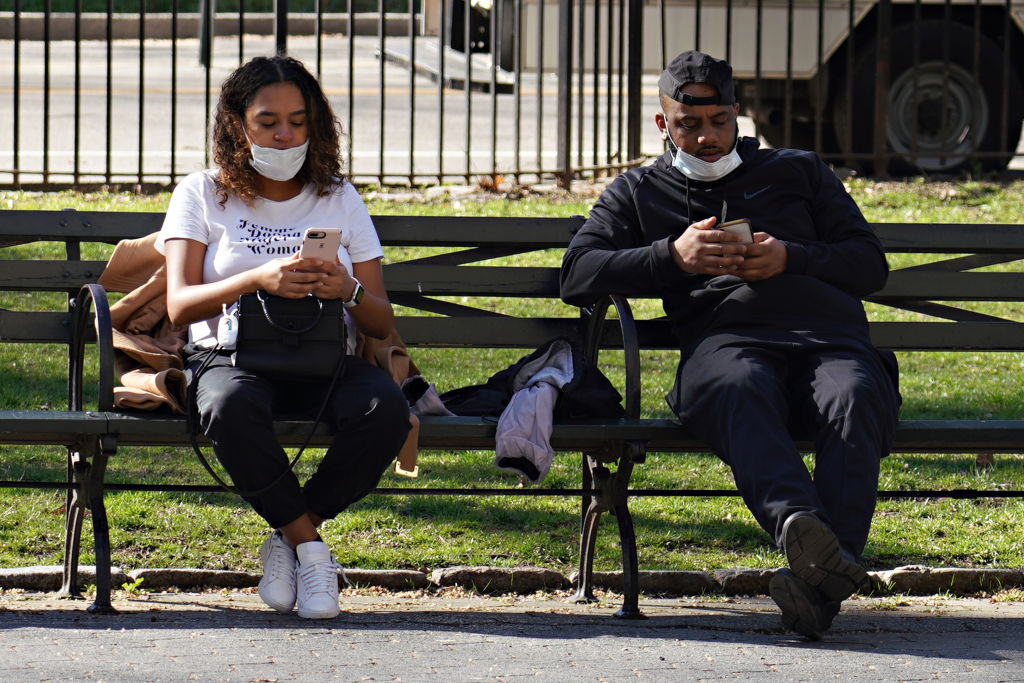
Two people sitting on a bench wearing protective masks using their phones as the coronavirus continues to spread across the United States on March 27, 2020 in New York City.Cindy Ord / Getty
Crises have an illuminating quality. They shine a light on our relationships with each other and our communities, with our employers and our elected officials — and also with technology. As COVID-19 has driven us indoors we have responded by reaching out through our digital devices.
When the coronavirus gripped China in February, people in the country downloaded 222 million apps on their phones. When public schools in Cambridge, Massachusetts closed their doors in mid-March, students were sent home with Chromebooks to learn virtually. As the virus spreads to nearly every continent billions of people are receiving information, updates, and directives on their pocket computers. In a perverse sort of way, the coronavirus is highlighting how integral our digital connections are to modern life.
In revealing the depth of our digital connection, however, the current crisis also highlights a growing ambivalence toward our smartphone society. We’re happy to use social media with friends as we hunker down and are eager to keep abreast of news. But we’re uneasy about how our smartphones have been quickly repurposed by governments to track and surveil us in the effort to beat the virus.