Small Business Owners at the Barricades
Small business owners, who feature prominently in the anti-shutdown protests, occupy a unique place in capitalism’s class hierarchy — although many share the same kinds of struggles experienced by wage workers, as a class, they’re often drawn to the far right.
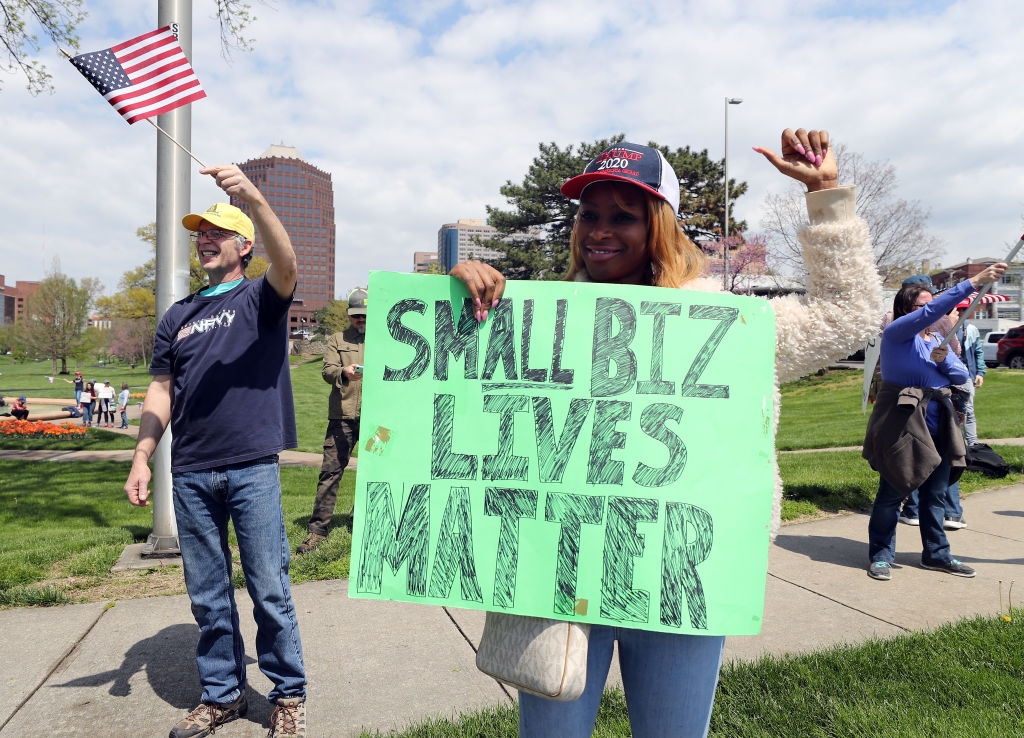
Protesters hold signs encouraging people to demand that businesses be allowed to open up, and people allowed to go back to work, at the Country Club Plaza on April 20, 2020 in Kansas City, Missouri. Jamie Squire / Getty
Last weekend, Minnesota state representative Mary Franson posted a video to social media in which more than a dozen Minnesotans pleaded with governor Tim Walz to lift his shelter-in-place order, allowing businesses to reopen and normal economic functions to resume. The video was stamped with the words “Open Up Minnesota” beneath an image of an open door inside the state’s silhouette.
The testimonial videos had been crowdsourced through the website of the Minnesota Senate Republican Caucus, which had put out a call asking for “input from business owners and workers to help get Minnesota operational as soon as possible.” For whatever reason, the caucus chose only to include submissions from women, all of whom were white and roughly between the ages of thirty and sixty-five.
Of particular note was the class composition of the women who voiced their dissatisfaction with Walz’s pandemic safety measures. The majority were small-business owners, including proprietors of multiple hair salons and massage parlors, a bowling alley, and a vacation rental. Many of the others were likely self-employed, including multiple swimming instructors and hair stylists. Only one of sixteen, a dental hygienist, cited a job that probably meant she appears on somebody else’s payroll.