The Lockdown Is an Opportunity to Redefine What Our Economy Is For
The COVID-19 crisis has shown that markets alone can’t meet our societies’ fundamental needs. But state measures to ward off economic collapse are just the start of a battle over the future — one where the principles of solidarity must be extended from health care to all aspects of society.
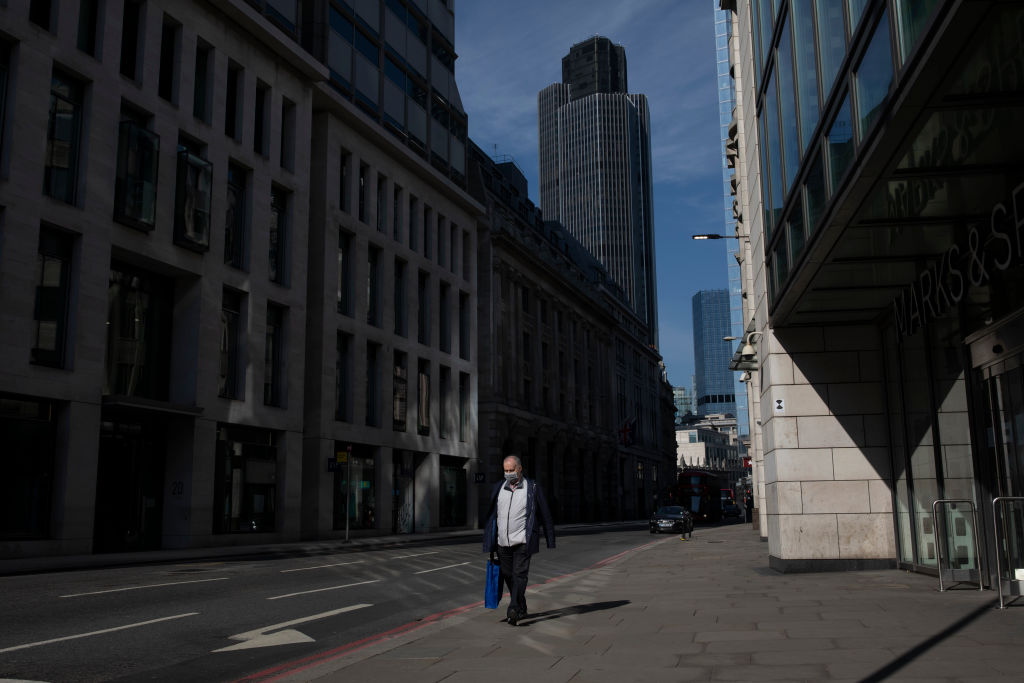
A man walks through the Square Mile on March 26, 2020 in London, England. British prime minister Boris Johnson announced strict lockdown measures urging people to stay at home and only leave the house for groceries, exercise, and essential travel to and from work. (Dan Kitwood / Getty Images)
COVID-19 has momentarily reversed our collective myopia: it is now easier to imagine the end of capitalism than the end of the world. But Fredric Jameson, to whom this phrase is often attributed, also left us with a warning. Increasingly, he speculated, we see “the attempt to imagine capitalism by way of imagining the end of the world” — in other words, the terminal logic of capitalism is apocalyptic. As the pandemic undoes capitalism’s logic, and the political establishment increasingly fights to preserve it, the future forks into new realms of political possibility. Our response could slingshot the world toward a better future, but it could equally accelerate the conditions for its decline.
Since the outbreak of the crisis, the threat of economic collapse has been the guiding anxiety among the political establishment on both sides of the Atlantic. Stock markets are plunging, airlines are pleading for bailouts, and the price of oil is falling to historical lows. “This feels much worse than 2008,” said Jason Furman, one of Barack Obama’s top economic advisers.
The response has flung wide open the “Overton window” of what is up for discussion. In the United States, Republicans could soon outflank Democrats in providing Social Security: Trump has suspended evictions and foreclosures, a measure that Obama refused to support even as millions were evicted from their homes in the wake of the financial crisis. In Germany, Chancellor Angela Merkel pledged to do “whatever it takes” to rescue crisis-hit companies — echoing former European Central Bank chief Mario Draghi’s infamous vow to rescue the euro at the expense of Greece’s economic sovereignty. In the UK, Chancellor Rishi Sunak’s stimulus package increased twice in the few days this article was being written. “We’ll find ourselves implementing most of Jeremy Corbyn’s program,” one Tory official said.