When “Anti-Populism” Makes the Far Right Mainstream
The French media has started lumping far-right leader Marine Le Pen with a host of other “populists,” left and right. But calling Le Pen just another populist helps her detoxify her party — and mainstreams the racist right.
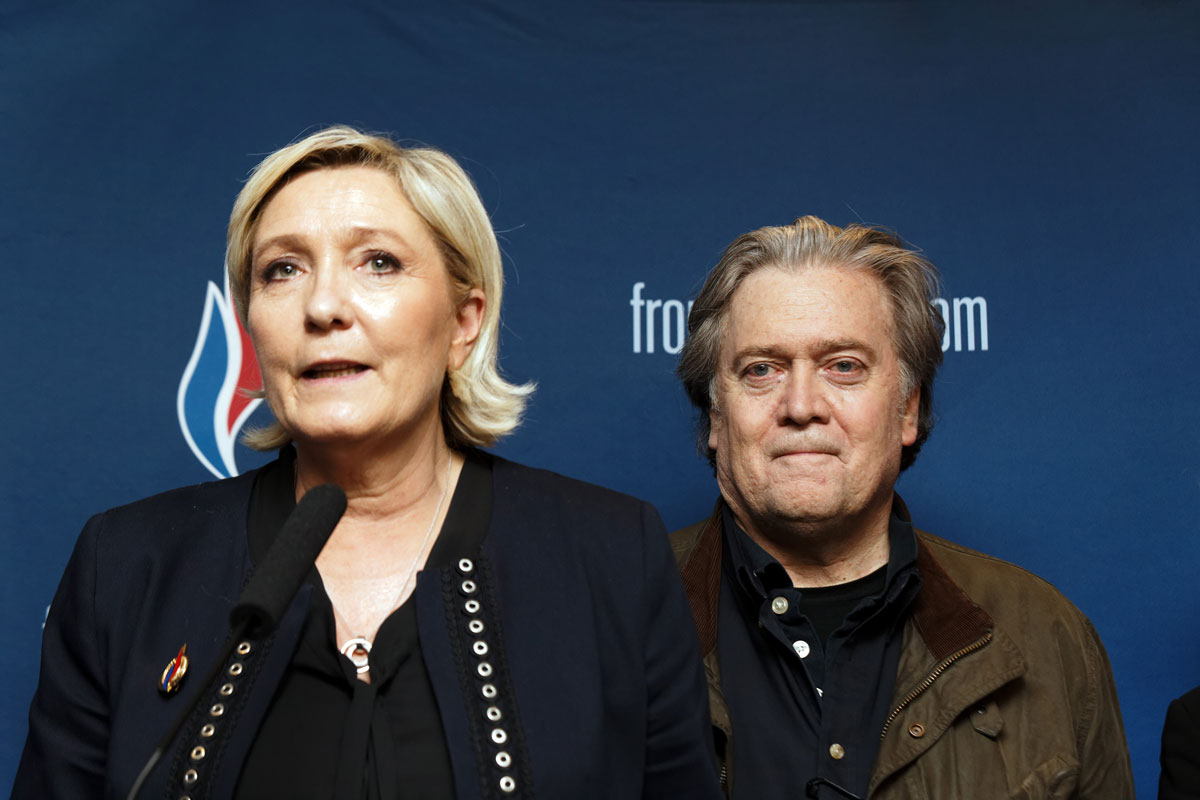
France’s far-right party Front National (FN) president, Marine Le Pen, and former adviser in the Donald Trump administration, Steve Bannon, give a joint press conference during the Front National annual congress on March 10, 2018 at the Grand Palais in Lille, north of France. (Sylvain Lefevre / Getty Images)
When the far-right Front National (FN) changed its name to Rassemblement National (National Rally, or RN) in June 2018, media commentary tended to follow a familiar pattern — taking party leader Marine Le Pen’s words at face value. The Associated Press interpreted the change as an indication of the party’s desire to “appeal to a broader range of voters.” It drew a similar, if rather odd, conclusion about the party’s modified logo: the organization’s “traditional flames” had been put “inside a partially closed circle to signal a new openness.”
A more skeptical eye might have discerned a rather closed kind of openness here, while a more informed one may have noted that the “traditional flames” were originally the emblem of the Movimento Sociale Italiano, a neofascist organization of die-hard Mussolini loyalists. More curious commentators did note the parallel between the new, voter-friendly name and the wartime collaborationist organization, the Rassemblement National Populaire, led by the rather less-than-voter-friendly Marcel Déat, cofounder of the French division of the Waffen-SS, whose soldiers fought in Nazi uniform to defend Hitler’s regime on the Eastern Front.
Two political narratives dominate media representations of the RN and the threat it poses to democracy. The first views the party’s supposed “dédiabolisation,” or “detoxification,” as some kind of watershed for the extreme right, evidenced by the public stance Le Pen has taken toward her father’s Holocaust negationism and antisemitism. The second, discussed below, sees President Emmanuel Macron as some kind of bulwark against the ambient threat of “populism.”